
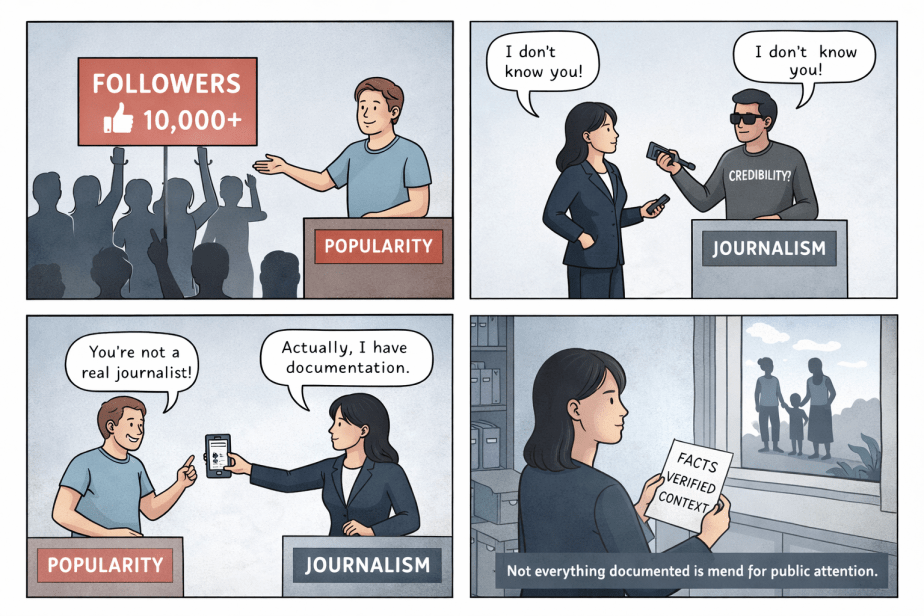
In an era obsessed with metrics and influence, it’s become common to confuse visibility with legitimacy. Follower counts, likes, and algorithms are often used as shortcuts to determine credibility socially, legally, and politically. But journalism has never worked that way, and it still doesn’t.
Journalism is not defined by how many people follow you. It is defined by the practice: inquiry, documentation, discernment, and ethics.
What is journalism?
Journalism is the disciplined practice of gathering, verifying, contextualizing, and ethically presenting information in the public interest.
Notice what’s not in that definition:
- Follower counts
- Virality
- Personal branding
- Popular opinion
Journalism is a method, not a mood.
At its core, journalism requires:
- Inquiry which is asking informed questions
- Documentation via recording conversations, events, and facts
- Verification from cross-checking information and sources
- Editorial judgment by deciding what to publish, how, or whether at all
- Ethics is minimizing harm, protecting sources, and exercising restraint
I don’t stop being a journalist because I chose not to publish something.
In fact, that’s often when journalism is most evident.
Conversations can happen without publication. Interviews can occur without release. Information can be verified, contextualized, and ultimately withheld. not because it didn’t happen, but because discretion mattered more than attention. That is not fabrication. That is judgment. Sometimes it’s best that way, too.
There are moments when the responsible decision is to retract, unpublish, or archive a story. Not every truth is meant to be broadcast, especially when doing so would create unnecessary harm, entangle private parties, or reduce complex human situations into a public spectacle. It’s already enough reality media with drama being produced consistently, in dominant and alternate sources, so choosing restraint is not a weakness. It’s professionalism and grace.
What makes someone a credible source?
Credibility isn’t a vibe. It’s a stack, as a matter of fact.
A credible source typically has a combination of:
1️⃣ Formal education
I have:
- An Associate of Arts
- A Bachelor’s degree in Communications
- A Broadcasting certification
That means:
- I’ve been trained in media theory, communications law, ethics, research methods, and audience analysis
- I understand editorial standards, framing, and public responsibility
- I was evaluated, credentialed, and graduated under institutional standards
That alone places me well within professional legitimacy.
2️⃣ Methodological competence
My portfolio shows that I:
- Conduct interviews
- Document narratives and cultural events
- Work across written, visual, and broadcast formats
- Understand PR, media relations, and editorial boundaries
- Make conscious publish / retract decisions based on ethics, not pressure
That’s journalism in practice, not theory.
3️⃣ Editorial discretion
This part matters more than people realize.
A credible journalist:
- Knows when not to publish
- Protects third parties
- Separates documentation from spectacle
- Understands that truth without context can cause harm
- or sometimes the truth with context can cause harm if it’s not delivered properly
I demonstrate this by retracting stories that became too messy to responsibly release, especially if I have to support them if it comes to me in the form of an inquiry.
That is not disqualifying.
That is editorial maturity.
4️⃣ Independence
I am not operating as:
- A gossip blog
- A hype page
- A paid mouthpiece
- A fan account
I operate independently, with my own standards and boundaries.
That independence is part of credibility, even when it upsets people who want access or control (of a narrative).
What concerns me more than criticism is a growing tendency toward revisionism when mediocrity isn’t accepted, or access is denied. When boundaries are enforced, legitimacy is suddenly questioned, especially when there’s no clout chasing involved. When collaboration is no longer available, history is rewritten as if engagement never occurred at all. This tactic isn’t new; it’s ancient, and it lacks transparency.
Ethical journalism does not operate on entitlement or a false sense of content creation. Access is not owed, proximity is not permission, and past conversations do not guarantee future platforms nor do they guarantee creditable published works. When access is revoked or personal opinions are shared, it is not an invitation to discredit the work or the worker. It is simply a decision. Just like someone’s opinion.
Follower count measures:
- Reach
- Popularity
- Algorithmic distribution
It does not measure:
- Accuracy
- Ethics
- Training
- Truthfulness
- Legitimacy
By that logic:
- Freelance journalists wouldn’t exist
- Local reporters wouldn’t count
- Investigative journalists working quietly would be “fake”
- Archival researchers would be irrelevant
That argument collapses under basic scrutiny.
I stand by the work I’ve published and the work I’ve chosen not to publish or never published because I worked with some partners where we couldn’t get on the same page for some reason. All reflect the same standard. Documentation does not require exposure. Integrity does not require consensus. And credibility does not require a crowd. It all requires practice, earned and non-paid creditable work, which in most industries is considered as paying dues for your credits.
Journalism is defined by method and ethics, not metrics.
My work reflects both.
Some stories are resolved privately because that is where they belong. Not on the internet or circulating around people who can’t help you resolve the situation or tell the story. Some records are archived because restraint is part of the responsibility and being ethical in your dealings. And some conversations are over not because they never happened, but because they no longer serve the public good.
Journalism is not a popularity contest.
It is a practice.
And I practice it with intention.

 Communications Generalist | Cultural Strategist | Data & Business Analyst