
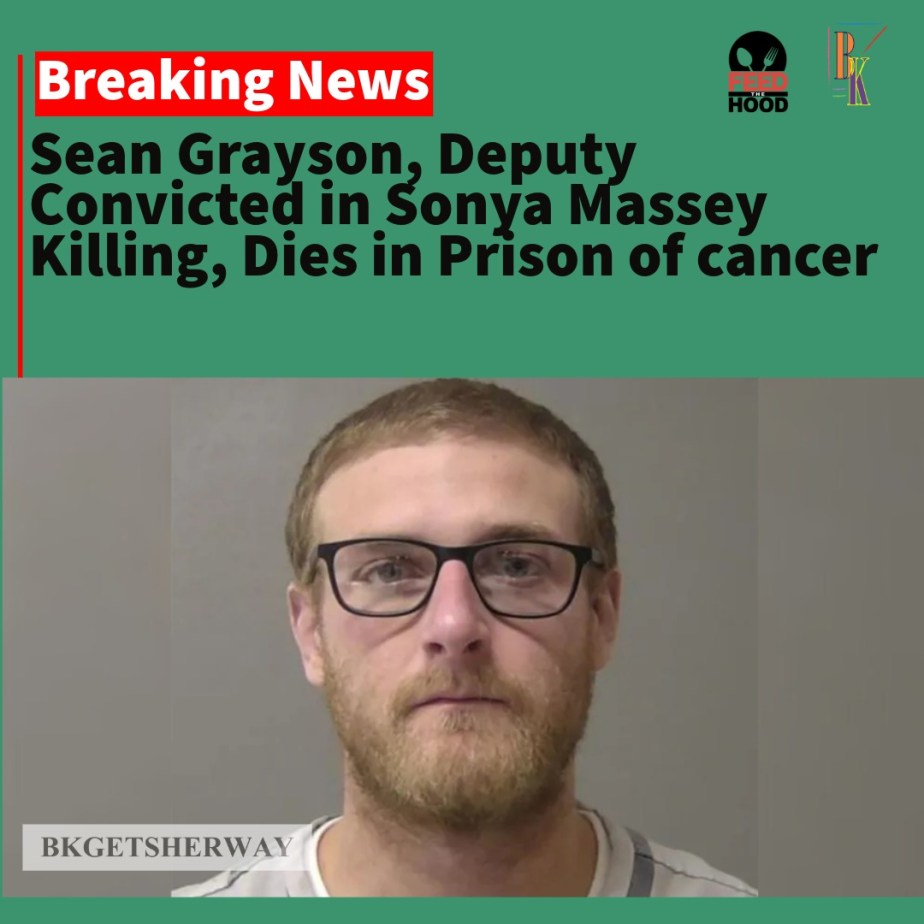
SPRINGFIELD, Ill. — The former Illinois sheriff’s deputy convicted of killing Sonya Massey inside her own home has died while in state custody, his attorney confirmed Sunday, closing out the criminal case in a killing that reshaped policing rules across Illinois.
Sean Grayson, 32, died Aug. 23, attorney Daniel Fultz said, without providing further details. Grayson had stage 4 colon cancer that had spread to his liver and lungs, and he was serving a 20-year sentence for second-degree murder at the time of his death.
His death came about three weeks after the Illinois Prisoner Review Board unanimously rejected his request for early medical release, despite his argument that he was nearing total medical incapacitation.
Grayson shot and killed Massey, 36, inside her Springfield-area home on July 6, 2024, after she called 911 to report a possible prowler outside. Body camera video later showed Grayson and another deputy entering her home, where Massey went to the stove to remove a pot of boiling water. As she held it, she told Grayson she rebuked him “in the name of Jesus.” Grayson drew his weapon and threatened to shoot her in the face, then fired three times as she ducked behind her kitchen counter, apologizing. One round struck her in the face, and she died within hours.
The Sangamon County Sheriff’s Office fired Grayson once the footage came to light. He had moved through several small Illinois police departments before joining the county, some of which had flagged concerns about his judgment. A jury convicted him of second-degree murder in October 2025, down from the original first-degree murder charge, and a judge handed down the maximum 20-year sentence in January 2026, plus two years of mandatory supervised release.
The case triggered protests across the state and drew a civil rights investigation from the U.S. Department of Justice, which later reached an agreement with the sheriff’s office requiring new training and a mobile crisis-response unit for mental health calls. Illinois lawmakers also passed the Sonya Massey Act, which requires police departments to review an applicant’s full work history before hiring them.
In the weeks before Grayson’s death, Massey’s family testified against his release request, arguing his diagnosis didn’t erase the danger he’d shown he was capable of. Sangamon County’s top prosecutor made a similar case to the review board. After news of Grayson’s death broke, relatives said it allowed them to finally begin grieving, since the ongoing legal proceedings had left little room to do so. The family’s attorneys said Massey’s killing was unjustified and that Grayson’s death doesn’t change that loss. A state senator who backed the post-shooting reforms said the community’s continuing push for policy change has offered the family some comfort.
Grayson’s death closes the criminal case, but the reforms his actions triggered look likely to be the more lasting mark on Illinois policing, a legacy shaped less by what happened to him than by what his actions cost Sonya Massey’s family and community.
Sources:
- Sean Grayson, former Sangamon County deputy convicted in killing of Sonya Massey, dies in prison, attorney says – CBS Chicago
- Sean Grayson, former Illinois deputy convicted of killing Sonya Massey, dies in prison, lawyer says – ABC News
- Sean Grayson, former cop convicted of killing Sonya Massey, dies – Chicago Sun-Times
- Sean Grayson, convicted in the death of Sonya Massey, has died – NPR Illinois
- Sean Grayson, former Illinois deputy convicted of killing Sonya Massey, dies in prison, lawyer says – CNN
- Sean Grayson, former cop convicted of killing Sonya Massey, dies | STLPR

