
Chicago’s Own: Ta’Rhonda Jones Brings Music, Storytelling & Soul to City Winery Chicago

Chicago native and Empire star Ta’Rhonda Jones is set to take the stage at City Winery Chicago on Monday, July 20th at 7:30 PM for a one-night-only evening blending music, storytelling, comedy and candid conversation. Best known for her breakout role as Porsha Taylor on FOX’s hit drama Empire, Jones brings her signature charisma and authentic South Side energy to an intimate live setting that showcases the many sides of her artistry beyond the screen.

Since stepping away from scripted television, Jones has built a second on-screen life as a host, most notably fronting Oprah’s OWN Network reality dating series The Never Ever Mets. The show follows couples who fell for each other online meeting in person for the first time, and Jones, known for her blunt honesty and warmth, guides them through cohabitation and relationship tests with the same grounded, relatable energy that made Porsha a fan favorite. She returned for Season 2, which premiered in spring 2025, cementing her place as one of OWN’s go-to hosts for unscripted storytelling. I’m looking forward to seeing her return to the screen.

The date holds extra meaning: it falls right around Jones’s birthday, and it’s a great gift to give someone who never asks for anything but shares everything. The show is a shared celebration with her fans not just for her Solar Return but for all of her recent milestones. Below is a recent Instagram post announcing the event, she wrote:

“It’s my B(earth)Day! 💫 If you’ve ever wanted to support me, this is the perfect way. Grab your ticket to my @citywinerychi show, celebrate with me, and you’ll automatically be entered into raffles for FREE artist resources… When you pour into me, I get to pour right back into our creative community. Let’s celebrate together. ❤️

Ticket buyers are entered into a raffle for artist development prizes, including a Billboard placement, a music video, and a Hype Magazine feature and more, tying the night directly to her broader mission of resourcing Chicago’s creative community.

The show comes on the heels of her latest album, Breaking Character, released June 6th. The 13-track project features collaborations with Teefa, SandyRedd, Joel Q, GLC, VAADI, Nathan Palmer, Mg Marz, and Philmore Greene, and has already drawn praise for its intentionality and cohesion, critics note the album’s replay value and the way its sequencing carries listeners through themes of identity and self-presentation. Fan-favorite tracks include “Villian” and “Feeling Good, Feeling Great.”

My favorites are “ Villain” , “Menace”, “Let Me Talk to Myself”, and “Favor on My Soul”.

Ta’Rhonda performing “Let Me Talk To Myself”

Jones’s Chicago roots run deep. Beyond acting and music, she’s the founder of the S.E.E.D. Foundation, a nonprofit dedicated to funding, mentoring, and resourcing emerging Chicago creatives through grants, studio access, and hands-on programming. Her impact will be formally recognized this year when she receives an Honorary Doctorate Degree in Humanity from Leaders Esteem Christian Bible University at its Fall Graduation Ceremony on August 23, 2026, in Atlanta. Announcing the honor, Jones reflected: “This isn’t just a title. It’s a testament… Y(our) FLYNESS… Dr. Ta’Rhonda Jones.”

Doors open at 6:00 PM at City Winery Chicago, 1200 W. Randolph St. Tickets are available now via City Winery’s box office.

George Johnson, Hair Care Industry Pioneer, Dies at 99

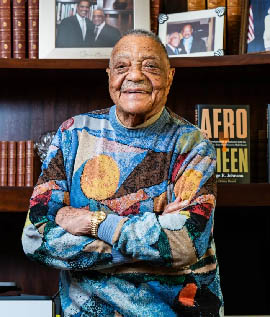
CHICAGO (AP) – George E. Johnson, who built one of the most successful Black-owned businesses in U.S. history through his hair care company, has died. He was 99.

Johnson died Monday of natural causes at his home in downtown Chicago, his son, John Edward Johnson, said.

Johnson founded Johnson Products Co. in 1954 after developing a hair straightener designed to avoid burning the scalp. He funded the startup with a small bank loan, which he obtained by telling the loan officer he needed the money for a vacation rather than revealing his business plans.

The company grew into a multimillion-dollar business and in 1971 became the first Black-owned company to trade on the American Stock Exchange. Its product lines, including Ultra Sheen and Afro Sheen, became widely used among Black consumers across the country.

Johnson Products’ advertising, created by Black-owned agencies, was known for depicting Black Americans in professional and family settings at a time when such portrayals were uncommon in mainstream media. The company also sponsored the television show “Soul Train.”

Johnson, a high school dropout who grew up poor on Chicago’s South Side, later gave millions of dollars to fund college scholarships for minority students.

He stepped down as chairman and CEO in 1988. The company changed hands multiple times in subsequent decades. Johnson published a memoir about his life and career in 2025.

He is survived by his wife, Madeline Murphy Rabb, four children and several grandchildren.

The Chicago Sun-Times contributed reporting. Featured Image Credit: Colin Boyle/Block Club Chicago.

Beyond the Outbreak: What a Foodborne Parasite Reveals About the Systems We Rarely See

The headlines are alarming: a growing outbreak of cyclosporiasis, an intestinal illness caused by the parasite Cyclospora cayetanensis, has sickened hundreds of people across the Midwest and prompted investigations by state and federal health officials. While the source of the contamination remains under investigation, the outbreak raises a larger question that extends beyond one contaminated food item.

What if the bigger story isn’t what made people sick but the system that allowed it to happen?

That question sits at the center of what I call The Systems Lens, an approach that looks beyond headlines to examine the infrastructure, policies, and processes shaping our everyday lives.

What happened?

According to the U.S. Centers for Disease Control and Prevention (CDC), Cyclospora is a microscopic parasite that spreads through food or water contaminated with human fecal matter. Unlike many stomach viruses, it is not typically transmitted directly from person to person because the parasite requires time in the environment to become infectious. Fresh produce has historically been associated with outbreaks because many fruits and vegetables are consumed raw and receive minimal processing before reaching consumers.

Health officials are continuing to investigate the current outbreak, and, as of publication, they have not identified a single confirmed food source responsible for every reported illness.

Why did it happen?

That is where the conversation often stops. News reports understandably focus on identifying the contaminated product. Public health investigators work to trace illnesses back through farms, distributors, and retailers. Those efforts are essential.

But there is another question worth asking.

How does human fecal contamination reach fresh produce in the first place?

The answer is rarely simple.

Contamination can occur through improperly treated irrigation water, sewage entering agricultural water supplies, contaminated wash water used during processing, flooding events, or inadequate sanitation infrastructure for agricultural workers. Each represents a different point where a safeguard intended to protect the food supply may have failed. None of these scenarios automatically means individuals are defecating in crop fields. More often, they reflect failures in water management, sanitation systems, or food-processing infrastructure.

Why should people care?

Food safety is not created at the grocery store. By the time lettuce, herbs, or berries reach your shopping cart, they have traveled through an interconnected system involving water management, agriculture, transportation, food processing, regulation, and retail distribution.

Every step depends on the one before it.

When one layer of protection fails, another is supposed to prevent contamination from reaching consumers. A widespread outbreak suggests that multiple safeguards may have broken down somewhere along the chain, even if investigators have not yet determined exactly where.

This isn’t about assigning blame to a particular farmer, company, or country. It’s about recognizing that public health depends on resilient systems, not perfect people.

What questions should we be asking next?

Instead of asking only, “What food made people sick?” we should also ask:

  • How is irrigation water monitored before it reaches crops?
  • How often are agricultural water systems tested for contamination?
  • What safeguards exist to prevent wastewater from entering irrigation supplies?
  • How transparent are food supply chains when outbreaks occur?
  • What investments in water and sanitation infrastructure could reduce future outbreaks?

These questions shift the conversation from reacting to the latest headline to preventing the next one and building a community.

Looking through the Systems Lens

Every major outbreak tells two stories. The first is about illness. The second is about infrastructure.

While scientists work to identify the immediate source of contamination, the public has an opportunity to think more broadly about the systems that produce, transport, and regulate the food we eat every day. Understanding those systems doesn’t make us fearful; it makes us informed. And informed communities are better equipped to ask better questions, demand greater transparency, and support stronger public health protections.

Sometimes the most important story isn’t the outbreak itself.

It’s the system the outbreak exposes.

Want to learn more about systems thinking?

This article uses what I call The Systems Lens, looking beyond individual events to understand the structures, incentives, and relationships that shape them. If you’re curious about the broader field of systems thinking, I recommend starting with The Donella Meadows Project’s “A Visual Approach to Leverage Points.” It’s one of the clearest introductions to seeing problems as interconnected systems rather than isolated events. Helping everyday people understand a complex subject.

Why Posting “I Do Not Authorize Meta” Won’t Protect Your Data

The difference between a declaration and a legally binding agreement

Every few months, a familiar message begins circulating across Facebook:

“I do not authorize Facebook or Meta to use my photos or personal data…”

It usually comes with urgent language about a “new rule,” references to a television program, an unnamed attorney, or a deadline that’s supposedly “tomorrow.” People copy and paste it with good intentions, believing they’re protecting their privacy. The problem? It doesn’t work. And I’m tired of seeing them. I once was a victim of reposting these, too, so I thought it would be great to share something I learned.

A declaration is not a contract

One of the most important principles in communications, business, and law is understanding the difference between making a declaration and entering into an agreement. A declaration is simply a statement expressing your wishes, opinions, or intentions. A contract, or the terms of service and privacy policy you agree to when creating and continuing to use a platform, is a legally binding agreement that defines the rights and responsibilities of both parties.

Posting a status update on your Facebook timeline does not amend, override, or replace the agreement you accepted when you created your account. Unless Meta officially changes its terms or provides a legal mechanism for opting out, a copied-and-pasted status has no legal effect.

In other words: Your declaration does not supersede the platform agreement you voluntarily accepted.

So does Meta own your photos?

According to Meta’s published policies, you retain ownership of the content you create. So no. However, by uploading content to Facebook or Instagram, you grant Meta a license to host, store, display, reproduce, distribute, and process that content so the platform can operate as intended. Without that license, Facebook couldn’t display your photos to your friends, show them across devices, or perform many of the basic functions users expect.

Ownership and licensing are not the same thing. Think of it like renting an apartment. You still own your furniture. But you’ve granted the landlord certain rights to operate the property according to the lease. Likewise, your content remains yours, but you’ve licensed Meta to use it under the terms you accepted.

What about artificial intelligence?

This is where the conversation becomes more nuanced.

Meta has acknowledged that it uses certain publicly shared content from adult users to improve and train its artificial intelligence systems. That reality has understandably raised questions about digital ownership, consent, and privacy. Those concerns are legitimate. But they should lead us toward understanding platform policies, not forwarding misinformation. A chain post cannot opt you out of AI training. Reading the platform’s privacy settings, limiting the audience for your posts, removing content you no longer wish to share, and understanding your rights are far more effective than reposting internet folklore.

Why these posts keep going viral

As someone who works in strategic communications, I find these posts fascinating. They spread because they combine three powerful ingredients: fear, urgency, and authority. Mention a lawyer. Reference a television show. Create a deadline. Tell people they must “copy and paste before tomorrow.” These are classic persuasion techniques designed to encourage sharing before verification. Ironically, the posts often accomplish the exact opposite of what they claim to promote: They encourage people to share information without checking the facts first.

Digital literacy is the new media literacy

The internet rewards speed and instant gratification. Wisdom rewards verification and credibility.

Before sharing anything online, ask yourself five questions: Who originally published this? Can I find an official source? Does this claim appear in the platform’s terms of service? Is there credible reporting confirming it? Is this encouraging me to react emotionally instead of thinking critically?

Those five questions can prevent the spread of thousands of pieces of misinformation every day.

Protecting your privacy online is important. So is understanding how digital platforms actually work. The strongest defense isn’t copying and pasting a viral status. It’s reading the agreements you accept, understanding your privacy settings, exercising informed consent, and developing strong digital literacy skills.

In an era of artificial intelligence and algorithmic communication, our greatest protection isn’t fear. It’s knowledge and being willfully ignorant.

Question

What do you think? Have you ever shared one of these viral privacy notices before learning they weren’t legally effective? Join the conversation below and let’s discuss what real digital literacy looks like in the age of AI.

Sources

Illinois to Require ‘Bell-to-Bell’ Cellphone Restrictions in Schools Starting 2027

SPRINGFIELD, Ill. – Illinois schools will soon be required to limit students’ cellphone use from the start of the school day until dismissal under legislation lawmakers sent to Gov. JB Pritzker’s desk this year.

Senate Bill 2427 directs every public school board and charter school to adopt a “wireless communication device” policy by the start of the 2027-28 school year. At minimum, the policy must bar students from using phones, tablets, laptops, gaming devices and smart watches throughout the school day, including instructional time, lunch and passing periods, according to bill records maintained by the Illinois General Assembly. High schools have some flexibility to allow device use during lunch or between classes; elementary and middle schools do not.

The measure passed the Senate 55-2 and the House 102-3 before lawmakers adjourned their spring session June 1. Pritzker, who proposed the policy during his State of the State address, is expected to sign it.

“Every parent and educator knows the damage that unchecked screen time and social media can do to our children and how disruptive they can be in school,” Pritzker said in a statement after the bill’s passage.

The law carves out several exceptions. Students may use devices during emergencies, when a licensed physician, physician assistant or nurse practitioner determines a device is medically necessary, to fulfill an individualized education program, or if needed to access learning materials as an English language learner. Schools are barred from enforcing the policy through fines, fees, suspensions, expulsions or by involving school resource officers or police.

State Sen. Cristina Castro, D-Elgin, the bill’s lead Senate sponsor, said the goal is to help students refocus on schoolwork. “Teachers and students should be able to collaborate effectively without distractions standing in the way,” Castro said, according to a news release cited by NBC Chicago. In an interview with NPR Illinois, Castro said several teachers in her district had urged her to pursue the legislation.

The policy mirrors bans already adopted locally by some Illinois districts, including Elgin School District U-46 and Hinsdale Township High School District 86, according to NBC Chicago. Illinois joins a large majority of states that have adopted some form of statewide restriction on phones in schools, according to Illinois Policy, a nonprofit research organization; Indiana is among neighboring states with a similar law.

Supporters point to research suggesting phone restrictions can help classroom focus. NBC Chicago reported the governor’s office cited Pew Research Center survey data showing roughly three in four high school teachers consider phone-related distraction a major problem. NPR Illinois cited Rutgers University research finding that students in classes permitting phone use scored worse on final exams than peers in phone-free classes.

Not everyone welcomed the change. The Chicago Teachers Union has argued the policy could cut off a way for students to reach family during emergencies, including immigration enforcement actions, and that managing devices already falls to teachers as part of daily classroom routines, Illinois Policy reported. Supporters counter that the bill’s emergency exception is intended to cover those situations.

Educators who already restrict phones say enforcement remains a work in progress. Ashley Kolovitz, director of digital learning and innovation at Lake Forest Academy, a private school not covered by the new law but with its own device policy, told NPR Illinois that students often reach for phones out of habit. “Sometimes, I have to stop and collect them at the start of class if it keeps happening,” Kolovitz said.

Under the law, the Illinois State Board of Education must publish a model wireless device policy for districts by Sept. 1, and school boards must review their policies at least every three years.

Sources:

  • Illinois General Assembly, Bill Status of SB2427 – ilga.gov
  • Capitol News Illinois, “Cell-phone ban, loosening foreign language requirements among education bills to pass” (June 2, 2026)
  • NPR Illinois, “School cellphone ban is designed to help students focus” (July 7, 2026)
  • NBC Chicago, “Illinois legislature approves school cellphone ban, governor says he’ll sign” (May 31, 2026)
  • Illinois Policy, “Pritzker gets his school cell phone ban bill despite CTU opposition” (June 18, 2026)
  • Featured Image Credit: Akinyemi Gbadamosi