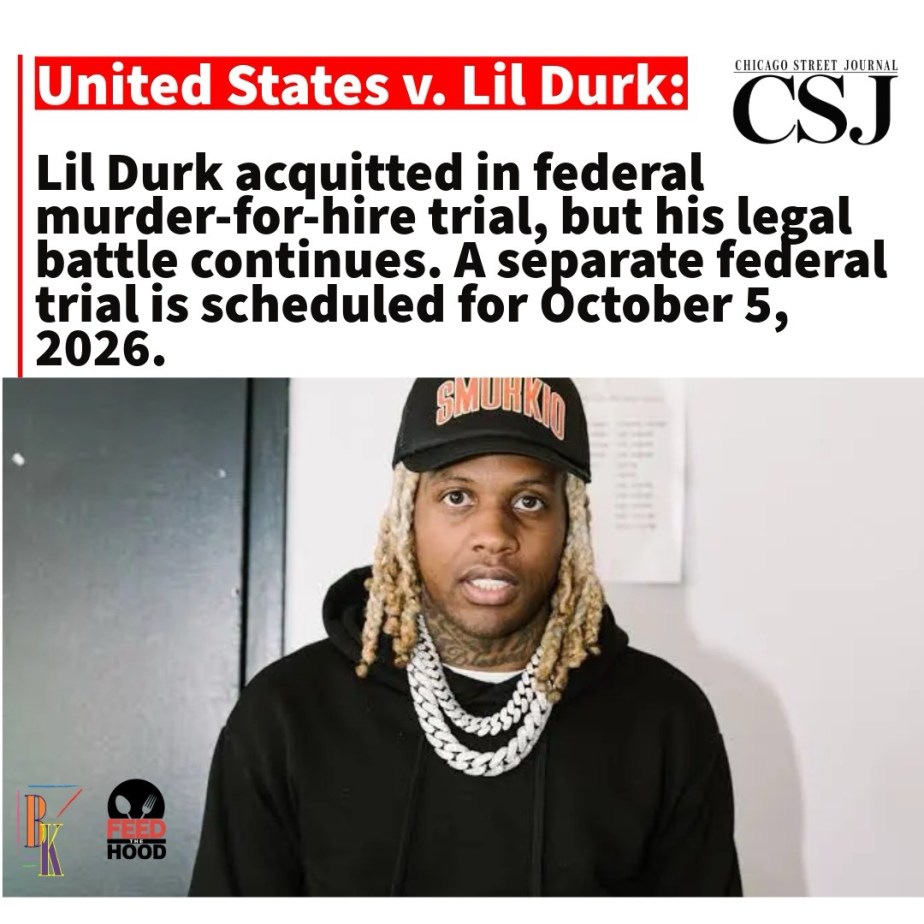
CSJ Legal Brief | United States v. Lil Durk: The Witnesses, the Million-Dollar Allegation and the Evidence Behind the Acquittal

Chicago Street Journal | Urban Culture & Affairs | Courts & Criminal Justice

Case: United States v. Durk Banks, et al.
Court: U.S. District Court for the Central District of California
Case No.: 2:24-cr-00621-MWF
Presiding Judge: U.S. District Judge Michael W. Fitzgerald
Verdict: September 11, 2026

Question Presented

How did federal prosecutors build a murder-for-hire prosecution around cooperating insiders, travel, money, electronic communications and other evidence and still fail to prove beyond a reasonable doubt that Chicago rapper Durk “Lil Durk” Banks participated in the charged murder-for-hire conspiracy?

And underneath that question is another:

What did the government’s evidence actually prove, as opposed to what witnesses and prosecutors said that evidence meant?

That distinction is at the center of this case.


Short Answer

On September 11, 2026, a federal jury acquitted Durk Banks on all charges arising from the government’s prosecution of an alleged 2022 murder-for-hire plot targeting rapper Tyquian “Quando Rondo” Bowman.

Banks’s co-defendants Deandre “DeDe” Wilson and David “Browneyez” Lindsey were also acquitted of the murder-for-hire allegations, but the jury convicted Wilson and Lindsey of conspiracy to commit stalking, stalking with a dangerous weapon and stalking resulting in death. The jury deliberated for three days. (AP News)

That split verdict is significant.

The jury was willing to find criminal responsibility for portions of the underlying conduct while declining to find Banks guilty of the offenses charged against him.

The verdict does not establish that every government witness lied. It does not tell us that jurors accepted every defense argument. Nor does it establish that Banks knew nothing about the events surrounding the shooting.

It establishes something narrower and legally critical:

Federal prosecutors did not prove Banks guilty of the charged offenses beyond a reasonable doubt.

Understanding why requires looking past the headline and examining the structure of the government’s case.


I. STATEMENT OF FACTS

From King Von’s Death to the Los Angeles Shooting

The government’s case originated in the aftermath of the November 2020 killing of Chicago rapper Dayvon “King Von” Bennett.

Federal prosecutors alleged that Banks sought retaliation against Quando Rondo, whose associate was involved in the Atlanta confrontation that resulted in Bennett’s death.

Nearly two years later, on August 19, 2022, gunmen attacked Bowman’s group near the Beverly Center in Los Angeles.

Bowman survived.

His cousin, Saviay’a “Lul Pab” Robinson, was killed.

Prosecutors alleged that Banks orchestrated a murder-for-hire plot targeting Bowman and that people associated with his Only The Family organization traveled to California and participated in the operation.

Banks pleaded not guilty.

His defense maintained that Banks did not order the killing and sought instead to place responsibility for organizing the attack on his former assistant, Kavon “Vonnie” Grant.

After approximately two weeks of testimony and three days of deliberations, the jury acquitted Banks. (AP News)

That chronology establishes the background.

It does not, by itself, establish who ordered the attack.

That was the disputed question the government had to prove.


II. WHAT THE GOVERNMENT HAD TO PROVE

Understanding the verdict requires understanding the actual law.

Federal murder-for-hire is governed principally by 18 U.S.C. § 1958.

The Ninth Circuit’s model criminal jury instruction identifies three fundamental elements the government must prove beyond a reasonable doubt.

First, the defendant must use, cause another person to use, or conspire to use a facility in interstate or foreign commerce or engage in the corresponding interstate travel covered by the statute.

Second, the defendant must act with the intent that murder be committed.

Third, the defendant must intend that the murder occur in exchange for something of pecuniary value. (Ninth Circuit Court)

That third requirement deserves attention.

“Murder-for-hire” doesn’t necessarily require completed payment.

Under federal law, “pecuniary value” can encompass money, commercial interests or other things whose primary significance is economic advantage. Ninth Circuit authority also recognizes that a promise of economic advantage can qualify even when the promise isn’t legally enforceable. (Ninth Circuit Court)

Therefore, the simplistic argument:

“Nobody got paid, so there couldn’t have been murder-for-hire”

……is legally incomplete.

But the opposite shortcut is equally problematic.

The government still had to establish the required connection between the murder and the alleged economic bargain.

As the Ninth Circuit instruction explains, the defendant must clearly understand that the thing of economic value would be given or received in exchange for the murderous act. (Ninth Circuit Court)

In plain English:

Where was the bargain?

Who offered what?

To whom?

What was promised?

What evidence established the agreement?

And most importantly for Banks:

What evidence proved that Banks knowingly participated in that bargain?

Those questions bring us to the government’s witnesses.


III. THE GOVERNMENT’S THEORY

Prosecutors did not present the alleged conspiracy as one isolated conversation.

They assembled a circumstantial and testimonial case.

The government pointed to relationships among Banks and members or associates of OTF; interstate travel; lodging and transportation; financial resources; electronic communications; the movements of alleged participants; and testimony from people who admitted participating in the events surrounding the attack.

Prosecutors argued that these pieces formed one picture:

Banks wanted retaliation, supplied or enabled resources, and directed people around him toward killing Quando Rondo.

One of the government’s most consequential witnesses was Banks’s former assistant, Kavon Grant.

Grant admitted participating in the August 2022 attack and testified that he did so because:

“Durk told us to.”

That is direct testimonial evidence of the government’s theory, but it still depended on jurors believing Grant. (LA Magazine)

And Grant wasn’t the government’s only insider.


IV. THE DEFENSE THEORY

Banks’s lawyers did not need to prove who actually masterminded the shooting.

The burden remained with the government.

But the defense supplied jurors with an alternative explanation.

It portrayed Grant, not Banks, as the person responsible for organizing the attack and argued that cooperating witnesses had powerful incentives to transfer responsibility upward to Banks.

The defense attacked the credibility of witnesses who admitted criminal participation and subsequently cooperated with federal prosecutors.

That created a recurring evidentiary question:

When does insider testimony become proof, and when does it remain an accusation requiring stronger independent corroboration?

The prosecution could establish that an associate traveled.

It could establish that someone rented a vehicle.

It could establish that money changed hands.

It could establish that a cellphone traveled from one location to another.

But those facts still had to be connected to Banks’s intent and agreement to commit the particular crimes charged.

The government’s case therefore depended not simply upon proving events.

It depended upon proving what those events meant.


V. THREE INSIDERS

Three cooperating witnesses became especially important to understanding the prosecution:

  • Kavon “Vonnie” Grant
  • Kacey “OTF Jam” Hester
  • Keith “Flacka” Jones

Their importance creates both strength and vulnerability for the government’s case.

An insider can provide information an outside witness could never know.

But cooperating witnesses may also face their own criminal exposure and potential sentencing consequences.

That doesn’t make their testimony inherently false.

It makes credibility, motive and corroboration especially important.

The jury ultimately heard the insiders’ accounts alongside the government’s independent evidence and the defense’s challenges to their credibility.

And then it acquitted Banks.


VI. THE FLACKA QUESTION: WHO IS KEITH JONES?

Keith Jones is particularly important because his position in the prosecution changed.

Jones, also known as “Flacka,” was not originally merely a witness against Banks.

He was a defendant.

He was charged in connection with the same alleged murder-for-hire scheme before later pleading guilty and becoming a government witness.

By the time of Banks’s trial, Jones was testifying for the prosecution about an operation in which he acknowledged participating. Courtroom reporting confirms that Jones testified immediately before Grant. (LA Magazine)

That history explains something that can look suspicious when documents from different stages of the prosecution are compared.

Jones can appear prominently among defendants in earlier case materials but not alongside Banks among the defendants whose guilt the September 2026 jury was deciding.

Based on the public evidence reviewed for this brief, that does not establish that Jones was secretly erased or “wiped” from the federal case.

His procedural status changed.

Defendant → guilty pleader → cooperating government witness.

That distinction is important enough that Chicago Street Journal is treating Jones’s plea and cooperation history as a separate reporting question rather than assuming what happened from changing document captions alone.


VII. THE $1 MILLION ALLEGATION

One allegation has traveled particularly far outside the courtroom:

Lil Durk allegedly placed a $1 million bounty on Quando Rondo.

But journalism requires us to ask:

Who actually heard what?

Jones’s testimony, as reported from the courtroom, was not simply that Banks personally approached Jones and offered him $1 million.

Reporting on the testimony describes Jones saying that Deandre “DeDe” Wilson told him Banks was offering $1 million for Quando Rondo’s killing. (XXL Mag)

The evidentiary chain being described is not simply:

Banks → Jones

It is:

Banks allegedly → Wilson allegedly → Jones.

Therefore, saying:

“Flacka testified that Durk personally offered him $1 million”

would overstate what Jones reportedly testified to.

The more precise formulation is:

Jones testified that Wilson told him Banks had offered a $1 million bounty.

Precision isn’t semantics here.

It’s evidence.


VIII. THE PAYMENT PROBLEM

Jones also testified about what happened after the attack.

According to courtroom reporting, Jones said he repeatedly sought compensation but Banks never paid him for his participation in the attempted attack. (XXL Mag)

Again, that does not automatically defeat a § 1958 prosecution.

Federal murder-for-hire law can encompass a promise or agreement involving economic value even if the promised benefit isn’t ultimately delivered. (Ninth Circuit Court)

But it creates an obvious evidentiary question:

If this was murder-for-hire, what evidence establishes the hire?

The prosecution didn’t necessarily need a canceled check marked “Quando hit.”

Criminal conspiracies rarely arrive gift-wrapped.

But prosecutors still needed evidence from which jurors could find the required economic agreement beyond a reasonable doubt, and Banks’s participation in it.

That makes the absence of a completed payment only part of the story.

The larger issue is whether the testimony, communications, money and other evidence sufficiently established the bargain itself.


IX. WHAT WAS CORROBORATED?

This may be the most important question in the entire case.

Strip away conclusions for a moment.

The government had evidence capable of establishing significant surrounding events and relationships.

It also had participants willing to tell jurors what they said those events meant.

But those are two different categories of evidence.

Suppose independent records establish that Person A flew from Chicago to Los Angeles.

That proves travel.

Suppose financial records establish that Person B paid for a hotel.

That proves a financial transaction.

Suppose cellphone data places Person C near a particular location.

That can establish location.

But none of those facts automatically answers:

Who ordered a murder?

The prosecution’s cooperators supplied crucial connective tissue.

Grant supplied perhaps the most direct version when he testified:

“Durk told us to.” (LA Magazine)

The defense consequently had an obvious strategic target:

the credibility of the people supplying the connection between Banks and the crime.

That’s why this case cannot be understood merely by counting how many pieces of evidence prosecutors introduced.

The better question is:

Which pieces independently established Banks’s criminal intent, and which pieces acquired their incriminating meaning primarily through a cooperating witness’s interpretation?

That question deserves a document-by-document examination.


X. THE VERDICT

On September 11, the jury returned its answer to the charges.

Banks was acquitted on all counts.

Wilson and Lindsey were acquitted of the murder-for-hire-related charges but convicted of conspiracy to commit stalking, stalking with a dangerous weapon and stalking resulting in death. (AP News)

The split verdict is worth studying.

Jurors were plainly capable of convicting defendants before them.

They did.

But they did not convict Banks.

That does not permit us to reverse-engineer the jury room and declare exactly which witness jurors believed or disbelieved.

A general verdict doesn’t provide that information.

What we can say is:

After hearing the government’s evidence and the defense’s challenges, the jury concluded that prosecutors had not proven Banks guilty of the charged offenses beyond a reasonable doubt.

Anything more specific requires evidence of the jurors’ reasoning that we presently do not have.


XI. WHAT THE VERDICT DOES NOT MEAN

This matters because criminal verdicts routinely get flattened on social media.

Not guilty does not mean “the jury proved he was innocent.”

The defendant doesn’t carry the burden of proving innocence.

The government carries the burden of proving guilt.

Likewise, the acquittal does not establish:

that every cooperator lied;

that every government allegation was fabricated;

that nothing criminal happened;

or

that everyone surrounding Banks was innocent.

In fact, the same jury convicted Wilson and Lindsey on stalking-related offenses. (AP News)

The legally accurate conclusion is considerably simpler:

The government did not prove its charges against Banks beyond a reasonable doubt.


XII. THE QUESTION AFTER THE ACQUITTAL

The verdict leaves us with a better journalistic question than:

“Did Durk do it?”

The question is:

Where did the government’s evidentiary bridge fail?

Was it cooperating-witness credibility?

Was it insufficient independent evidence establishing who gave the alleged order?

Was the million-dollar allegation too dependent upon communications passed through other people?

Did the financial evidence establish spending without sufficiently establishing a murder-for-hire bargain?

Could prosecutors establish the actions of the participants without proving Banks knowingly joined their criminal agreement?

Did jurors accept some government evidence but reject the inference prosecutors wanted them to draw from it?

Or did several of these problems converge?

The verdict itself doesn’t tell us.

The record might.


XIII. HIP-HOP ON TRIAL

There is another story underneath United States v. Banks.

It concerns what happens when hip-hop culture enters a federal courtroom.

Relationships become evidence.

Lyrics can become evidence.

Slang becomes something lawyers ask jurors to interpret.

Record-label and entourage finances can become potential evidence.

Travel becomes evidence.

Social-media posts become evidence.

The actions of employees, friends and associates can become evidence offered against an artist alleged to occupy a leadership position.

None of those categories is automatically legitimate or illegitimate evidence.

The journalistic responsibility is to distinguish between:

what the evidence objectively establishes

and

the interpretation prosecutors or defense attorneys ask a jury to place upon it.

That’s particularly important when jurors may not share the cultural vocabulary of the people whose communications they’re evaluating.

A lyric can have meaning.

A slang term can have meaning.

An artist paying an associate’s expenses can have meaning.

But determining what those things prove in a criminal prosecution requires considerably more than recognizing that they sound suspicious.

There is a difference between cultural interpretation and legal proof.

This case sits directly at that intersection.


XIV. LEGAL TERMS IN PLAIN ENGLISH

Indictment

A formal criminal accusation returned by a grand jury. An indictment states what prosecutors allege. It is not evidence that the allegations are true.

Superseding Indictment

A replacement indictment. Prosecutors may use one to add, remove or modify defendants, charges or factual allegations.

Defendant

A person formally accused of a crime in the case.

Co-defendant

Another person charged in the same prosecution or related proceeding.

Cooperating Witness / Cooperator

Someone who provides information or testimony to prosecutors. Cooperators are sometimes themselves charged with crimes and may hope their assistance will be considered when they’re sentenced.

Cooperation does not automatically make testimony true or false.

Plea Agreement

An agreement under which a defendant agrees to plead guilty under specified terms. Some plea agreements also contain cooperation obligations.

Conspiracy

In general terms, an agreement between people to commit a criminal offense.

A defendant doesn’t necessarily have to personally perform every act of the underlying crime to face conspiracy liability. But mere friendship or association with someone who commits a crime isn’t itself enough to establish participation in a conspiracy.

Murder-for-Hire | 18 U.S.C. § 1958

The federal offense at the center of this prosecution.

Under the Ninth Circuit model instruction, prosecutors must establish the required interstate-commerce component, intent that murder be committed, and intent that the murder occur in exchange for something of pecuniary value. (Ninth Circuit Court)

Pecuniary Value

Something primarily carrying economic value or advantage.

That can include money, commercial interests and other economically valuable benefits. (Ninth Circuit Court)

Quid Pro Quo

Literally, “something for something.”

In the murder-for-hire context, the important concept is an exchange: the economic benefit is connected to the requested murder rather than being unrelated generosity or ordinary financial activity.

Direct Evidence

Evidence that directly addresses a fact if believed.

Grant’s testimony that “Durk told us to,” for example, directly alleges an instruction. (LA Magazine)

Whether a jury believes the witness is a separate question.

Circumstantial Evidence

Evidence from which another fact can reasonably be inferred.

Travel records, location data and financial transactions can all be circumstantial evidence.

Circumstantial evidence is not automatically inferior to direct evidence.

Corroboration

Independent evidence supporting another piece of evidence or a witness’s account.

If a cooperator says a defendant gave an order, an independently authenticated message expressing that same order could potentially corroborate the testimony.

Hearsay

Generally, an out-of-court statement offered to prove the truth of what it asserts.

But “hearsay” does not automatically mean inadmissible. Federal evidence law contains numerous exclusions and exceptions, including rules that can apply to statements made during and in furtherance of a conspiracy.

Impeachment

Evidence or questioning used to challenge a witness’s credibility.

Prior inconsistent statements, certain biases, motives and other credibility issues can become subjects of impeachment.

Cross-Examination

Questioning of a witness by the opposing side.

Cross-examination allows lawyers to challenge what the witness remembers, whether accounts have changed and whether the witness has motives affecting credibility.

Beyond a Reasonable Doubt

The government’s burden of proof in a criminal prosecution.

The government must establish every required element of an offense beyond a reasonable doubt.

The defendant does not have to prove innocence.

Acquittal / Not Guilty

A verdict finding that the government did not prove the defendant guilty beyond a reasonable doubt.

It is therefore incorrect to automatically translate an acquittal into a factual finding about everything that did or did not happen.

Split Verdict

A verdict in which jurors reach different conclusions on different defendants or charges.

That’s what happened here: Banks was acquitted, while Wilson and Lindsey were acquitted of murder-for-hire-related allegations but convicted of stalking-related offenses. (AP News)

Severance

The separation of defendants or charges into different trials.

Banks remains in federal custody following this acquittal because he faces a separate trial currently scheduled for October 5 involving murder-related racketeering and weapons allegations. Those remain allegations, and Banks remains presumed innocent of them unless proven guilty. (MarketScreener)


XV. WHAT COMES NEXT

The September 11 acquittal closes one chapter of Banks’s federal prosecution.

It does not end the broader federal case.

Banks remains in custody and, according to the U.S. Attorney’s Office information reported following the verdict, faces another trial scheduled for October 5 on separate murder-related racketeering and weapons charges. (MarketScreener)

For Chicago Street Journal, however, the work on this first trial isn’t finished.

The next phase is the record.

We are examining:

the indictments;

Keith Jones’s plea and transition from defendant to cooperating witness;

the cooperation agreements;

trial and evidentiary briefs;

jury instructions;

the alleged $1 million bounty;

financial records and alleged payments;

travel and lodging evidence;

cellphone and electronic evidence;

witness testimony and impeachment;

and the evidence that independently corroborated, or failed to corroborate, the government’s cooperators.

The objective isn’t to retry Durk Banks in the press.

It is to understand how one of the most consequential federal prosecutions involving a Chicago hip-hop artist was constructed, and why that prosecution did not produce a conviction against him.

Because an allegation isn’t evidence.

Evidence isn’t automatically proof.

And evidence itself can be undisputed while its meaning remains fiercely contested.

The jury has delivered its verdict.

Now we’re going into the documents.


PRIMARY LAW & SOURCE RECORD

U.S. Court of Appeals for the Ninth Circuit – Model Criminal Jury Instruction 16.7, Murder for Hire (18 U.S.C. § 1958). Defines the elements prosecutors must establish and explains “pecuniary value.” (Ninth Circuit Court)

Associated Press – September 11, 2026. Contemporary verdict reporting confirming Banks’s acquittal, the three-day deliberation and Wilson and Lindsey’s stalking convictions. (AP News)

Reuters – September 11, 2026. Independent verdict reporting and confirmation that Banks remains detained pending the separately scheduled October prosecution. (MarketScreener)

Los Angeles Times – September 11, 2026. Courtroom reporting describing the competing prosecution and defense theories and the verdict. (Los Angeles Times)

Los Angeles Magazine – August 31, 2026. Courtroom reporting documenting Kavon Grant’s testimony concerning his participation and his allegation that Banks directed the group. (LA Magazine)

XXL – August 31, 2026. Courtroom reporting concerning Keith Jones’s testimony about the alleged bounty and his claimed attempts to obtain payment. Because these details presently rely on secondary courtroom reporting rather than a certified transcript in this brief, they are attributed accordingly. (XXL Mag)

Editorial Note

This brief distinguishes allegations, witness testimony, attorney arguments and established outcomes. Statements attributed to cooperating witnesses are their testimony, not independent findings by Chicago Street Journal. The September 11 verdict establishes that Banks was acquitted of the charges tried before this jury; it does not independently resolve every disputed factual question raised during the prosecution.

Banks remains in federal custody pending a separate federal trial currently scheduled for October 5, 2026, involving severed murder-related racketeering and weapons charges. Those allegations were not decided by the September jury, and Banks remains presumed innocent of them unless and until the government proves them beyond a reasonable doubt.

Chicago Street Journal will continue reviewing the court record and following developments in the upcoming prosecution.
Chicago’s Own: Ta’Rhonda Jones Brings Music, Storytelling & Soul to City Winery Chicago

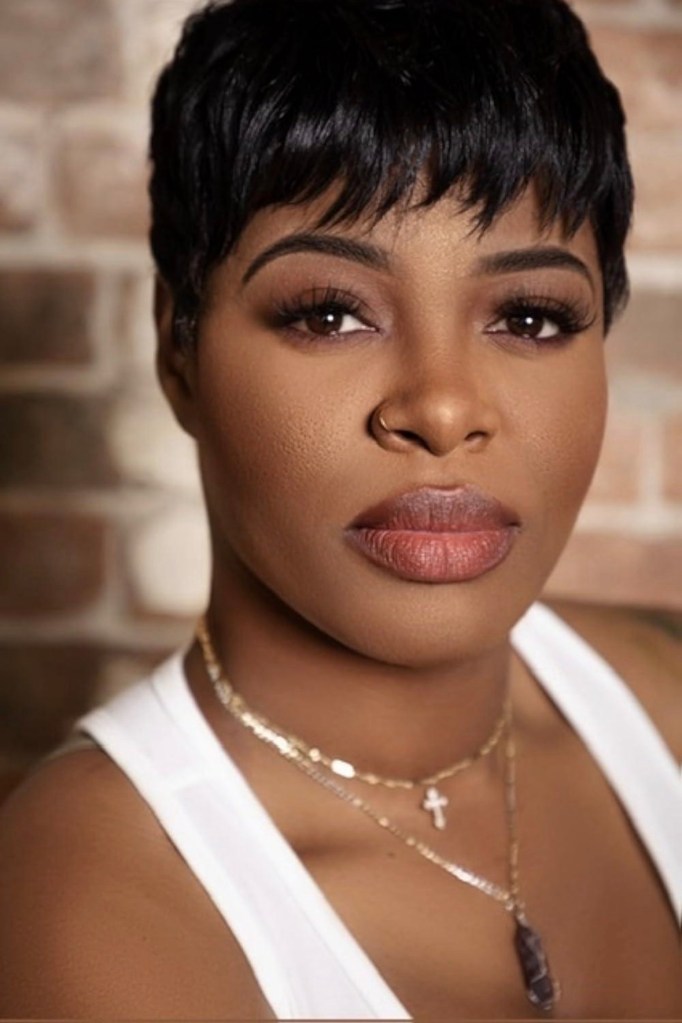
Chicago native and Empire star Ta’Rhonda Jones is set to take the stage at City Winery Chicago on Monday, July 20th at 7:30 PM for a one-night-only evening blending music, storytelling, comedy and candid conversation. Best known for her breakout role as Porsha Taylor on FOX’s hit drama Empire, Jones brings her signature charisma and authentic South Side energy to an intimate live setting that showcases the many sides of her artistry beyond the screen.

Since stepping away from scripted television, Jones has built a second on-screen life as a host, most notably fronting Oprah’s OWN Network reality dating series The Never Ever Mets. The show follows couples who fell for each other online meeting in person for the first time, and Jones, known for her blunt honesty and warmth, guides them through cohabitation and relationship tests with the same grounded, relatable energy that made Porsha a fan favorite. She returned for Season 2, which premiered in spring 2025, cementing her place as one of OWN’s go-to hosts for unscripted storytelling. I’m looking forward to seeing her return to the screen.

The date holds extra meaning: it falls right around Jones’s birthday, and it’s a great gift to give someone who never asks for anything but shares everything. The show is a shared celebration with her fans not just for her Solar Return but for all of her recent milestones. Below is a recent Instagram post announcing the event, she wrote:

“It’s my B(earth)Day! 💫 If you’ve ever wanted to support me, this is the perfect way. Grab your ticket to my @citywinerychi show, celebrate with me, and you’ll automatically be entered into raffles for FREE artist resources… When you pour into me, I get to pour right back into our creative community. Let’s celebrate together. ❤️“

Ticket buyers are entered into a raffle for artist development prizes, including a Billboard placement, a music video, and a Hype Magazine feature and more, tying the night directly to her broader mission of resourcing Chicago’s creative community.

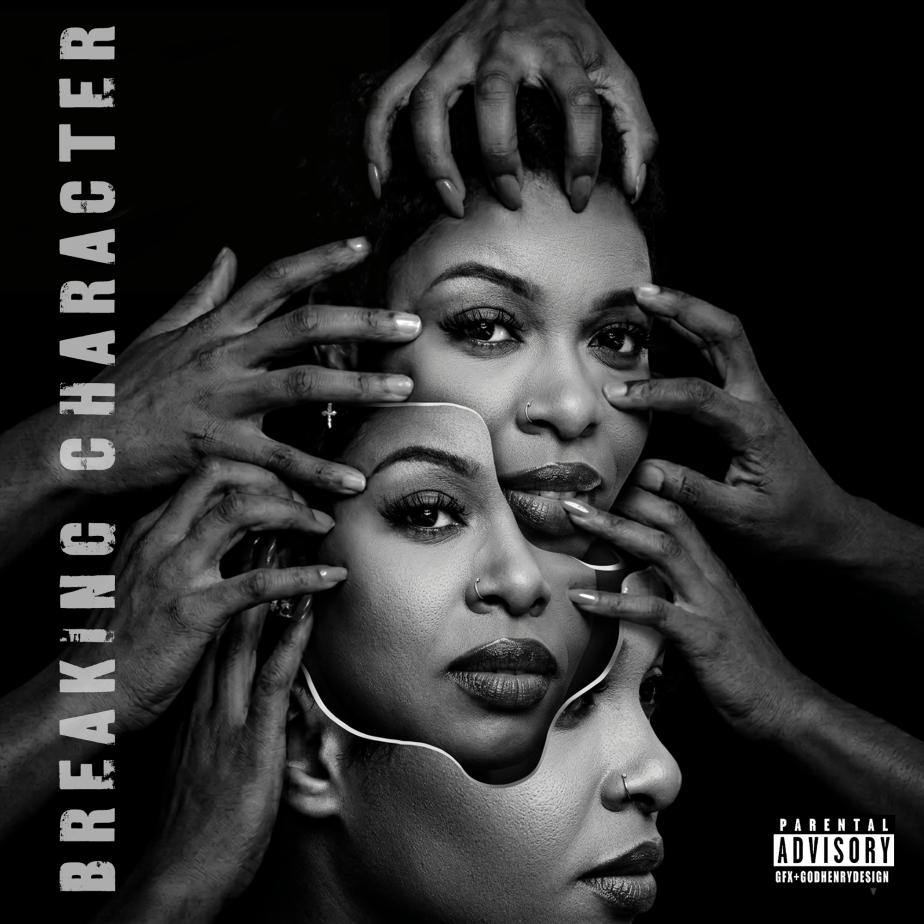
The show comes on the heels of her latest album, Breaking Character, released June 6th. The 13-track project features collaborations with Teefa, SandyRedd, Joel Q, GLC, VAADI, Nathan Palmer, Mg Marz, and Philmore Greene, and has already drawn praise for its intentionality and cohesion, critics note the album’s replay value and the way its sequencing carries listeners through themes of identity and self-presentation. Fan-favorite tracks include “Villian” and “Feeling Good, Feeling Great.”

My favorites are “ Villain” , “Menace”, “Let Me Talk to Myself”, and “Favor on My Soul”.

Ta’Rhonda performing “Let Me Talk To Myself”

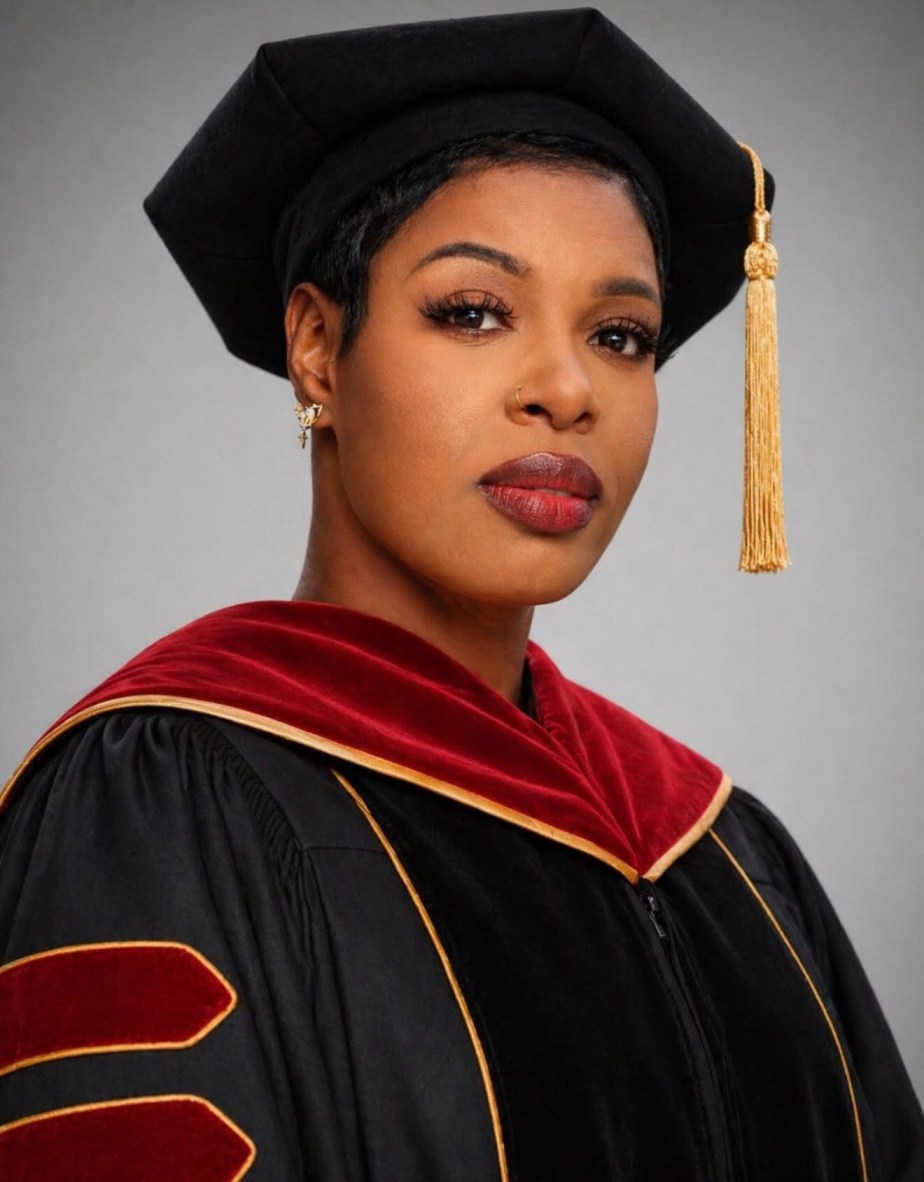
Jones’s Chicago roots run deep. Beyond acting and music, she’s the founder of the S.E.E.D. Foundation, a nonprofit dedicated to funding, mentoring, and resourcing emerging Chicago creatives through grants, studio access, and hands-on programming. Her impact will be formally recognized this year when she receives an Honorary Doctorate Degree in Humanity from Leaders Esteem Christian Bible University at its Fall Graduation Ceremony on August 23, 2026, in Atlanta. Announcing the honor, Jones reflected: “This isn’t just a title. It’s a testament… Y(our) FLYNESS… Dr. Ta’Rhonda Jones.”

Doors open at 6:00 PM at City Winery Chicago, 1200 W. Randolph St. Tickets are available now via City Winery’s box office.


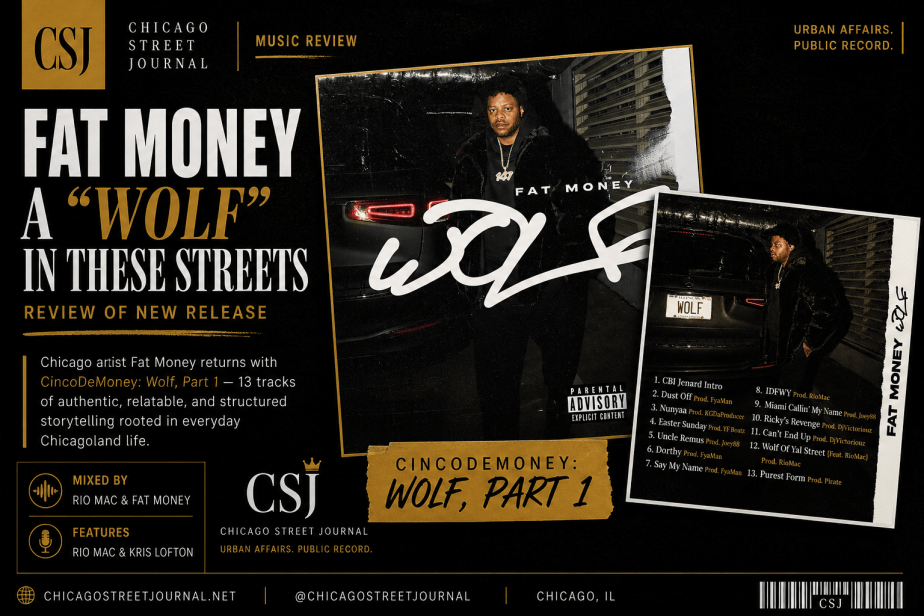
Fat Money a “Wolf” in These Streets: A Review of CincoDeMoney Wolf, Part 1

Chicago-Ty Money, better known as Fat Money, returns with new music: 13 tracks in his signature style for this year’s CincoDeMoney installment, Wolf, Part 1.

This project is one I anticipate annually. Not just out of loyalty , but because the series consistently reflects authenticity and growth. Each year feels like a continuation, not a repetition.

Money still slaps the same way he did the first time I pressed play years ago. And I still spin the older records too. That consistency matters.

Beyond affiliation, because yes, this is family, the work stands on its own. The quality is there. The storytelling is structured. The themes are grounded in everyday Chicagoland life. There’s intention in the sequencing and delivery that many artists today struggle to maintain.

It’s narrative and a vibe.

The project was mixed by Rio Mac and Fat Money, with features from Rio Mac and Kris Lofton, adding texture without disrupting the tone.

Favorite Tracks

In no particular order:

  • Nunyaa
  • Dust Off
  • Easter Sunday
  • Purest Form
  • Dorthy
  • Miami Calling My Name
  • IDFWY
  • Honorable Mention:
    Wolf of Y’all Street

A personal highlight for me is the recurring nod to my family’s restaurant legacy.

My uncle, Chuck “Woo Woo’s” Higgins, built something lasting from Washington Heights (99th & Halsted) to Lynwood, Calumet City, Dolton, Chicago Heights, and now:

1721 E. Sauk Trail in Sauk Village.

When artistry intersects with legacy, it hits different.

Wolf, Part 1 feels like a reminder: evolution doesn’t mean abandoning your roots. It means sharpening them.

Ta’Rhonda Jones explores identity and transformation in the upcoming project “Breaking Character.”

CHICAGO — Actress and recording artist Ta’Rhonda Jones is expanding her creative work into music with Breaking Character, a project centered on identity, perception and personal transformation.

The project includes tracks such as “Favor on My Soul” and “Villain,” which explore contrasting emotional perspectives, one rooted in alignment and affirmation, the other in perception and misunderstanding.

“Breaking character is really about stepping outside of what people expect from you,” Jones said. “It’s personal.”

Jones, known for her role as Porsha Taylor on the television series Empire, is using music to expand her storytelling beyond the screen.

“I choose to be present. I choose to be 100% me,” she said. “No more performing. No more people pleasing. I’m no longer who society wants me to be.”

The duality presented in “Favor on My Soul” and “Villain” reflects a broader theme of balance within the project.

“I wanted to show that balance is necessary,” Jones said. “I can be both soft and firm. Soft says I understand you, and firm says I still choose what’s best for me.”

Production for “Favor on My Soul” is underway, with visuals emphasizing tone, reflection and transformation. The project’s visual direction aligns with its themes, focusing on mood-driven storytelling and emotional depth.

“There are moments where you’re misunderstood for growing,” Jones said. “That’s where ‘Villain’ comes from.”

Jones also described the creative process as liberating, noting that each phase of development has expanded her perspective.

“Every time I create, I discover new freedom,” she said. “It feels like a phoenix rising, like I’ve unlocked a new level of consciousness.”

A release date for Breaking Character has been confirmed for June 6. The project marks Jones’ continued expansion into music and visual storytelling, positioning it as a personal and creative evolution.


Follow her on IG!
Ta’Rhonda Jones | IMDb
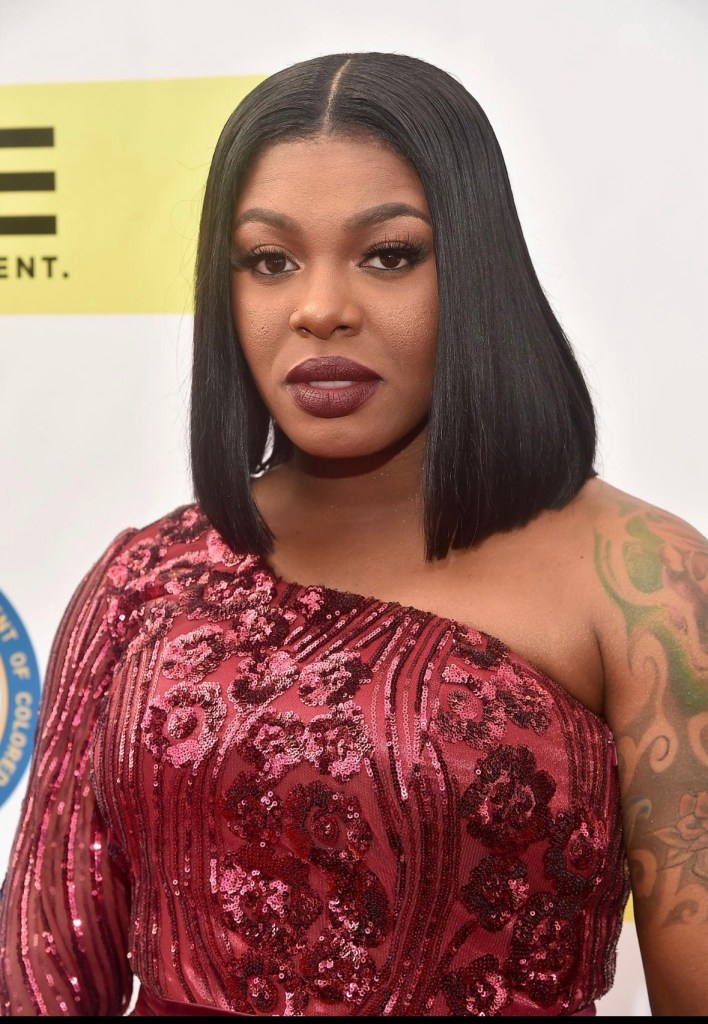
Ta’Rhonda at 48th NAACP Image Awards Red Carpet
Ta’Rhonda at the 2016 Essence Festival Presented by Coca-Cola
Ta’Rhonda at The 47th NAACP Image Awards Presented by TV One, Red Carpet
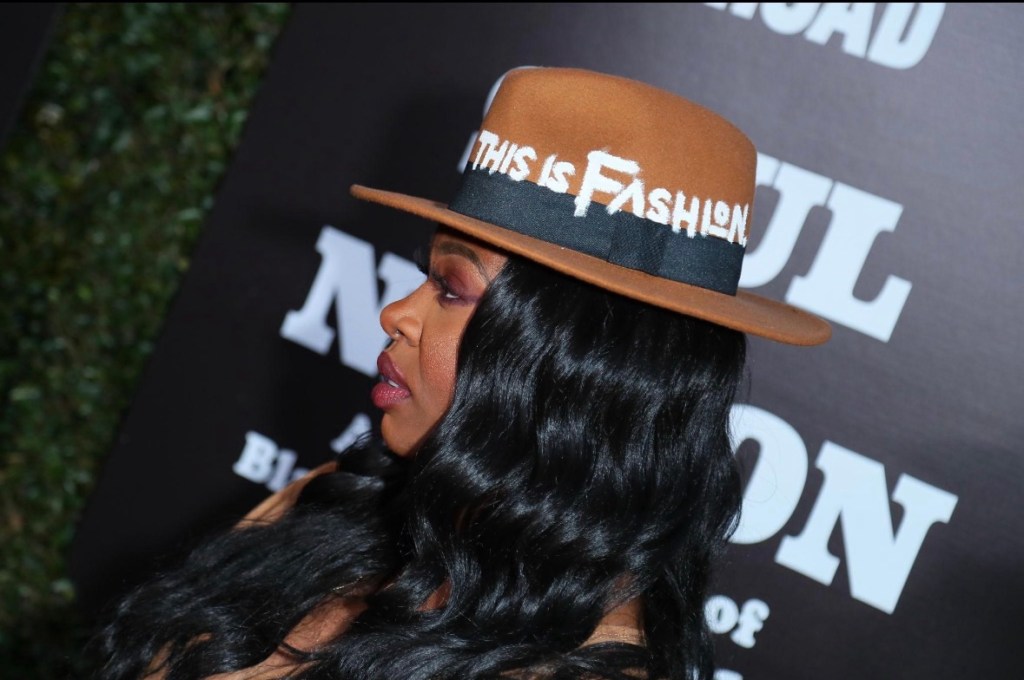
Ta’Rhonda | The Broad Host West Coast Debut of “Soul of a Nation”

Easy O’Hare Brings Nightmare O’Hare to Life on Friday the 13th 😈

Chicago – On the notoriously eerie date of Friday the 13th, Easy O’Hare fused horror and hip-hop in a way only he could, with the release of his latest album, Nightmare O’Hare. Held at The New Jo’s Bar and Grill in Merrillville, Indiana, the release event transported fans and peers into an immersive experience where sound collided with storytelling in a night full of adrenaline, ambiance, and authenticity.

But what’s the big deal with Friday the 13th?

For centuries, the number 13 has carried a reputation for bad luck, and when it lands on a Friday, that superstitious energy hits different. The fear is so widespread it has its own name: paraskevidekatriaphobia. Pop culture took it even further in 1980 with the horror classic Friday the 13th, introducing Jason Voorhees; the silent, masked killer who haunted Camp Crystal Lake and slashed his way into horror history. Since then, the date has come to symbolize fear, suspense, and rebellion; making it the perfect backdrop for Easy O’Hare’s latest creative strike.

His statement? It’s giving serial killer energy.

And he’s killing these other rappers especially when it comes to the way he curates his musical projects.

Nightmare O’Hare captures that chaotic yet calculated vibe. It’s raw, cinematic, and deeply unsettling in the best way. The album rides moody production and vivid lyricism, exploring the gritty realities of urban life, survival, and the kind of darkness you face when you’re moving a certain way.

When I rap it gets scary for the competition and we chose a beat selection that fit the mood of how scary it can actually get. With this project I was showing I can pop up outta nowhere with new music at any given time after my listeners hear Nightmare O’Hare they’ll definitely go download the past projects to get all the way tapped in with me.


The theme originated from a past rap beef where I had to switch forms from Easy O’Hare to nightmare

-Easy O’Hare

The Performance

Easy’s stage presence brought the music to life with gritty emotion and undeniable power. And the supporting acts? Just as heavy. The room was charged with energy, filled with people who came to show love and stayed to be moved. It was a whole vibe and yes, the chicken was fire too.

The Artist

  • Rico Moneyy
  • Kdoug Jr
  • Aboog
  • D’kno Mr.KNOITALL
  • ESC Deez
  • Fly cool club
  • Big Nastee
  • Easy O’Hare
  • Coldhard

The Bigger Picture

With Nightmare O’Hare, Easy doesn’t just drop music, he curates experiences and releases projects with precision. He proves that there’s room for 40-year-old rappers who trap 🏚️🪤 with strategy, successfully. This isn’t a moment; it’s a method.

Nightmare O’Hare is now streaming on all major platforms.

Stay tuned for visuals, BTS moments, and more drops by following him on Instagram: @easyohare_


Mama Cecile  Johnson thoughts on Day 8 Women’s Conference Oct 26, 2024 –

Will the legacy of our generation be a series of broken promises?

Nelson Mandela

Mama’s  talk today  highlighted a number of ways African women had become to their detriment. From their relationship with each other to the role mothers and mothers-in-law now played, which is usually seen as negative. I was surprised to learn how negative mother-in- laws were seen as that had not been my expectation as we in the West see African families in a more positive way.

When she spoke of the challenge of the “feminine, that up to now, we have never had women solving the problems of women or humanity.” And how this disconnection came about it was a sad awakening for many.  

The lack of a female messiah was another observation raised, as well as a call for women who could help to address the needs of women to the Kings, Queens and First Ladies of Africa. A continent where few women seemed to rule. She asked why? Why did we think we should not and why were we not capable? She correctly highlighted that men have been making the decisions for the continent and it was clear that the outcomes were poor. She saw this as women becoming cowards, because here they were blaming men for everything but not standing up and demanding their right to do something about it. Taking control of their destiny required their action not someone’s approval. And failure to take action would mean that eventually women’s lives would get worse not better.

She tied this to the lack of women identified as Messiahs and the need for women to become messiahs. Why did we accept that only men could be a messiah? Why did we mimic other races in everything  except success, and look at the outcomes. As she cataloged our bad behavior as women she asked the question,  “With the beginning of a Renaissance: Was it our  choice to make new history or repeat history.”

I want to thank Mama for her message today on the courage lacking in our women today. It’s an observation I have also made in my years as an activist. When I would go before the School Board or community groups to speak about our failing schools and children I would tell community members that being a woman, a mother, someone who carried a child 9 months in the belly, suckled and raised that child, who else should speak on behalf of our children? Who else should be upset when a police officer who did not know your child, abused or killed them? I found it very frustrating how Black women in the USA were the only women who were expected to not feel for their children, themselves or their communities. So I spoke up.


When I hear you speak on the observations I myself have made as to the state of our affairs it makes my blood boil. And I heard your request and want you to know, sign me up. For you are correct when you say. “who but women should speak on women’s behalf?” Who should call our sisters out, and model the behavior needed while empowering women to be the change they wish to see in their lives? That has always been my motto. I AM the change I wish to see.

In 2013 I did my Master’s Thesis on Maternal Mortality in Africa (“DISCRIMINATION TO DEATH” Exploring the Issue of Maternal Mortality in Africa).  It was part of my research as I looked at so many factors (The MDGs) impacting African life which the world did not seem to care about.

My passion for Africa was born a long time ago my children say, but for me it became crystal clear when I attended a Global Poverty Forum in Denver, Colorado in 2008 and heard one of the speakers proclaim “that in the year 2050, the average income for the US would be $90,000, the average income for China and India would be $45,000 and the average income in Africa would be $1,800. And that Africa had the richest resources in the world.” Immediately I questioned, how could that be, that forty two years from now the world’s expectation for Africa would be so low? How could it be that the richest continents inhabitants could still be so poor?  Who was using the resources and what was causing this delay in Africa’s development?

There began a quest for me to understand more about this continent called Africa, one whose portrayal always links the mind to images of corrupt leaders, strongman dictators, military coups, civil war, HIV/AIDS, malaria, disease, starvation, malnutrition, dying children, lack of infrastructure, foreign debt and genocide. Yet Africa has the richest resources in the world, so why weren’t they being used to benefit her people?

Even as I documented so many challenges I had to focus on one item for my thesis and so I chose Maternal Mortality In Africa, because the numbers were so outrageous (US 11/100,000 live birth- white /33/100,000 Black and in Africa many places over 500 -900/100,000 even as some of the things impacting us now our ancestors had already conquered hundreds of years before. Like C- sections.) It was clear to me no one cared about Black women dying in Africa, similar to the response in the US, where the death rate was minuscule compared to Africa, but still disproportionate.

And it broke my heart that Nelson Mandela  in 2002 asked “will the legacy of our generation be a series of broken promises?” and that from then they had already predicted Africa would not meet its Millenium Development Goals by 2015, with 13 years to go. I am here to say YES, that is Africa’s legacy, “A whole series of broken promises” “ organized chaos” and incompetent and disingenuous leadership.  And we should be ashamed to have allowed it to get so bad.

My presentation on why we need an African Development Plan looks at these critical issues, health, education, infrastructure etc. and lays out some of the things needed to unite our people around common causes concerning us. Even designing something we labeled as a Kingdom Project as short term solutions to restoring Kingdom relevance on the continent.

I know your frustration for I have created and sent my work to fools claiming they were interested in development of our people and most of them were men, happy with their big titles and positions who were accomplishing nothing.  It has been a frustrating journey, so I am happy to meet you and Baba. Your passion is my own and your effort is similar to mine except yours is spiritual and I had not included that in my calculations even as I would say “this is a spiritual war we are fighting.” It took this last year training under Rev Kwame to understand what that truly meant.  Its as if my mouth would speak hoping my ears would hear.  Thank God it’s hearing now.

I am here to sign up for your classes and efforts and help create the plan of action. I agree we need to say and do more and I don’t lack courage.  It is a joy to finally meet some people of true courage and big hearts. Who have lived experience, not just book knowledge.  

Your summary of the situation was very sad. The mechanization of sex, children, lovers, lack of desire for each other, replacement of humanity with toys and robots.  How far we have sunk these last few decades as others have risen and our population of consumers are enamored with all of this foolishness, to our detriment.

So thank you Mama for once again being a breath of fresh air. Do not cry anymore for some of us are here to help you.  We heard your cry and we do plan to do something about it.

Love you Mama, I hear your heart.

Your daughter,


Cecile

Visit Mama Cecile’s website, here’s the original version.

Celebrating the Heart of Education: National Teachers Day & Week

Chicago, IL– National Teachers Day and National Teachers Week are dedicated to honoring and appreciating the contributions of educators in the United States. The history of these observances’ dates back to the 1940s.

  • Early Advocacy: The idea for a day to honor teachers was first proposed by Eleanor Roosevelt in 1953. She persuaded Congress to set aside a day to recognize educators.
  • National Teachers Day: In 1980, the National Education Association (NEA) and its affiliates began discussions with Congress about creating a day to honor teachers. The NEA and its affiliates continued to observe Teacher Day on the first Tuesday in March.
  • Presidential Proclamation: In 1985, the NEA Representative Assembly passed a resolution declaring the first whole week of May as National Teacher Appreciation Week. In 1984, the National Parent Teacher Association (PTA) established Teacher Appreciation Week as the first entire week of May.
  • Official Recognition: In 1980, Congress passed legislation officially designating National Teacher Day as the Tuesday of the first week of May. This became a national day to honor teachers.
  • Continued Recognition: National Teachers Day and National Teachers Week have been celebrated annually since then. Schools, communities, and organizations nationwide use this time to thank teachers for their dedication and hard work.
  • Global Observance: While the specific dates and names may vary, many countries worldwide have similar observances to recognize the contributions of teachers.

These observances allow students, parents, administrators, and communities to express their appreciation for teachers’ vital role in shaping the future.

Embracing a New Chapter: My Journey with Illinois School District 163 as a Communications Specialist

Photojournalist: TSA Media @ Tim Streetz Winter Solstice Release Party

Dear School District 163 Community,

I am thrilled to embark on a new chapter of my professional journey as the Communications Specialist for School District 163 handling all your public relations & communications needs. From the moment I stepped foot into our vibrant community, I knew that I was stepping into a world of boundless possibilities, where every interaction, every conversation, and every connection has the power to make a difference.

Joining School District 163 fills me with an overwhelming sense of excitement and purpose. As someone deeply passionate about effective communication and community engagement as a social scientist, engineer, and entrepreneur, I am eager to leverage my skills and experience to serve our district and support its mission of academic excellence and student success.

Communication is at the heart of everything we do, and I am committed to ensuring that our voices are heard, our stories are shared, and our community is united. Whether it’s through crafting engaging content, managing our digital platforms, or collaborating with stakeholders, I am dedicated to fostering open, transparent, and meaningful communication across all levels of our organization.

But beyond the day-to-day tasks and responsibilities, what truly excites me is the opportunity to be of service to each and every member of our district. Whether you’re a teacher, a parent, a student, or a community member, know that my door is always open, and my ears are always ready to listen. Your ideas, your feedback, and your concerns matter, and I am here to support you in any way I can.

As we embark on this journey together, I am filled with hope, optimism, and a deep sense of gratitude for the opportunity to serve such a dynamic and diverse community. Together, let us embrace the challenges, celebrate the successes, and continue to build a brighter future for School District 163.

I look forward to getting to know each of you, learning from your experiences, and working together to make our district the best it can be. Together, we are stronger, together, we can achieve greatness.

Below is some general information on my system and ways that we can collaborate.

Thank you for welcoming me with open arms, and I am honored to be a part of this incredible community.

Gratitude,

BK
Communications Specialist

When You Have Heroes as Friends: @SaintTheGoodBoy & Jesse James Saves the Day

Friday, September 7, 2018 King James (Jesse Stringer) and Saint “The Good Boy” (Lennell Davis) was looking for a party during after hours when they approached 79th Phillips and seen a building on fire.

I was told by a source that The Chicago Fire Department was on location and did not immediately respond to the fire. That’s what sparked both guys to go into the building on a rescue mission. Source reported that Jesse asked the Fire Fighters what were they waiting on to go into the building and one of the Fire Fighters responded by allegedly telling him to “go ahead and go in”.

I received a call from Saint shortly after they finished the rescue. For more information on the story, click link here, to get CBS2 Chicago’s account. They awkwardly produced their story deliberately stating that the The Chicago Fire Department’s Fire Fighters immediately responded, when I was told by a source, who was present, that they did not.

Nonetheless, it’s great to know that I have great friends/humans around who will sacrifice to ensure the well being of others. They could have kept riding and assumed that because the Chicago Fire Department was present they would take care of it. This is a good example of leadership and being an active citizen.

Cultural Comparison

Cultures are dynamic,and we cannot understand a relationship by only looking at two individuals’motivation, action, and behaviors (Flores, Martin, Nakayama).

Martin, J. N.,Nakayama, T. K., & Flores, L. A. (2008). Thinking about intercultural communication: dialectical approach to intercultural communication. In Readings in intercultural communication: Experiences and contexts (pp. 3-12). Princeton,NJ: Recording for the Blind & Dyslexic.

Mexican Culture and Chinese Culture

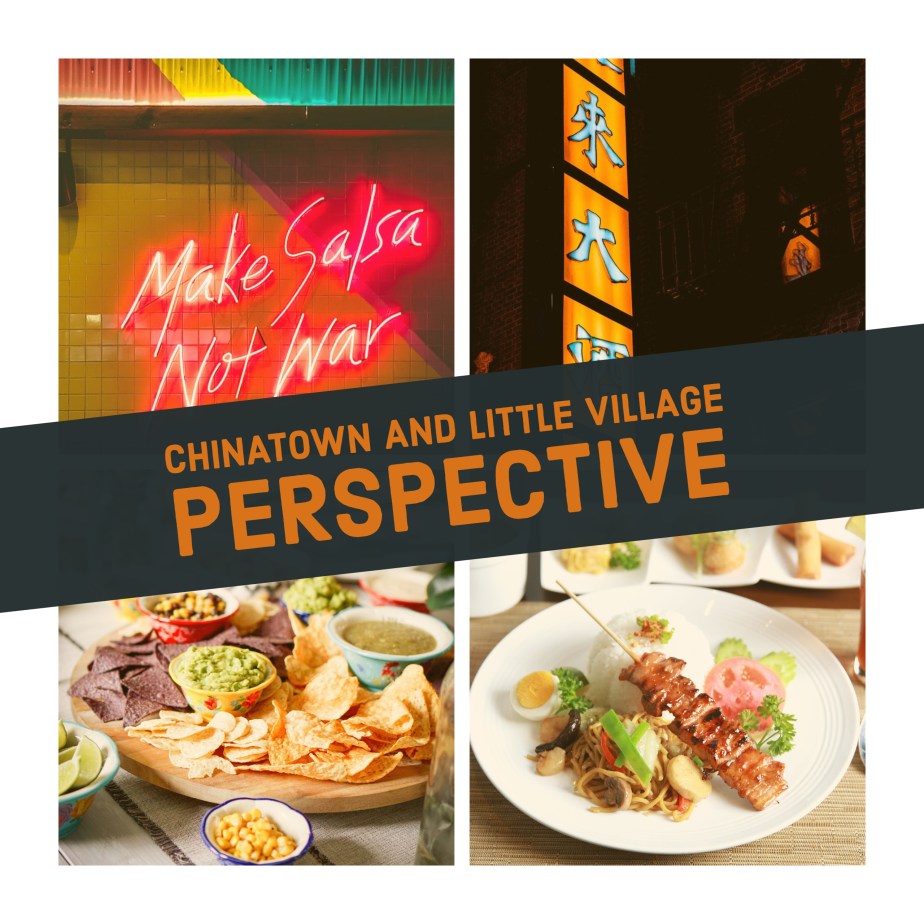
I visited a few cultural spaces this semester, and I was able to observe natural sociocultural in these spaces. I’m going to compare and contrast  two cultural spaces and time by music, foods, language, what I observed them do to past time, family, arts and craft.

Cultural Celebrations and Beyond

Mexican Culture

Cultural Artifact from tour 

When it comes to Mexican cuisine, it seems to always be filled with spices, especially hot spices for some Mexicans who hold true to their “roots”. Even some of their candy is spicy. While at the restaurant in Little Village, the cashier explained to me how spicy the Mexican hot chocolate was. She explained to me that the chili powder added is what makes it spicy. To my surprise, it was really good and fulfilling. It had a tingling spice to it, kind of like mint when fresh.

Mexican Spices
main spices 
Image result for what's in mexican hot chocolate
Mexican choices of fruits 

Their popular sauces are moles, which I learned is also a traditional base, it’s also referred to as mole poblano. According to the Mexican Food Journal, the popular Mexican salsa recipes are:

Tamales are another popular food of Mexican culture, along with tacos, enchiladas, their fresh tortillas chips and tostadas.

Mexican hot sauces 

 Mexican Day Parade, took place on September 9th this year. 

“The Mexican Day of Independence from Spain is September 16 (not May 5) (Gonzales & Rivera, pg. 165).” It’s assumed that Mexicans celebrate independence on Cinco De Miyo, which is May 5.


González, A., Chen, Y., &Willis-Rivera, J. (2016). Hispanic heritage month: not for members only.In Ourvoices: Essays in culture, ethnicity, and communication (6th ed.,pp. 165-173). New York, NY: Oxford University Press.

Family is very important to the Mexican culture. It’s a main focal point of their life.  They’re interdependent of their members across generations (González, A., Chen, Y., &Willis-Rivera, J., 2016).

Touch, affection, and greeting rituals are means of affirmation. In the Mexican American family, the formality given to greeting rituals is intended to keep both familiarity and distance.


González, A., Chen, Y., &Willis-Rivera, J. (2016). The rhetoric of la familia  among Mexican Americans. In Our voices: Essays in culture, ethnicity, and communication (6th ed.,pp. 165-173). New York, NY: Oxford University Press.

In spite of social and historical differences, there is a sense of cultural commonality among the societies of Central and South America, Mexico, and the Caribbean. The latter can be seen in aspects of social life as diverse as literature, music, television, political rhetoric, and oral storytelling.


González, A., Chen, Y., &Willis-Rivera, J. (2016). The cultural experience of space and body: a reading of  Latin America and Anglo-American comportment in public. In Ourvoices: Essays in culture, ethnicity, and communication (6th ed.,pp. 165-173). New York, NY: Oxford University Press.

While I was walking through the community, I noticed most families were with multiple family members. Some sets were made up of a daughter, grandmother or older aunt. It was a son and mother couple at the street food cart, they were purchasing fruit with cayenne pepper sprinkled on top. They were standing in close proximity of one another. The mother at one point leaned over to communicate with him. bending over speaking very close in his face. She didn’t seem upset but it was a personal relational act.

I spoke to everyone, and they were distant but they spoke and went right back to their task. I noticed churches that resembled roman catholic religions. I listened to them speak in Spanish and coming out of one of the retail store where there were cowboy boots being sold, was Spanish music. They were selling figurines of Elmo, Winnie the Pooh, and other American characters favorable to children.  This expressed their Mexican American transnational culture.

La Famila Among Mexican Americans
BK (I), in front of the Little Village Arch 

Chinese Culture

Chinese Lunar New Year 2018 started February 16, 2018. They had a Chinese Lunar New Year Dinner on February 20th  and a parade  on February 25th of 2018(Chicago Chinatown Chamber of Commerce).

While strolling through, I didn’t notice any street food carts or people vending on the streets, as I did in Little Village. Most merchants had storefronts where they sold their miscellaneous products such as vases, oriental glass items in the shape of pigs, cats, elephants, and china women.

According to China Highlights, the most popular dishes you should want to try is in Chinese Cuisine:

  • Sweet and Sour Pork
  • Kung Pao Chicken
  • Ma Po Tofu
  • Wontons
  • Dumplings
  • Chow Mein
  • Peking Roasted Duck
  • Spring Rolls

Cantonese cuisine is very popular in Chinatown. I spotted over 10 Cantonese restaurants.

spring rolls
Spring rolls 
dumplings
Dumplings 
Image result for Chinese Spices and herbs
Chinese herbs and spices 
Let’s talk family, values, and acts.
Mandarin Character that represents “family”

Chinese ethical values are based on how man should live life. They highly value their traditional and national value.In my video you can see a purple sign that reads K-Pop, the east side of Wentworth. If you didn’t know what street that was, now you do. So go check out some K-pop in Chinatown. K-Pop has been flowing, and is proof that Chinese are proud of Asian culture.

Chinese sell and use a lot of herbs. When I visited the stores, majority of them including the restaurants sold green tea and ginger root.  Arcana, the store I purchased sprilulina and ginseng from, was stocked with raw, dried, and liquid herbs. All products were in mandarin language with slight translations in English, except the lottery sign. Inside the store it was a small group. They seemed like family; it was two middle-aged Chinese women, two little girls, and a little boy. The two women were talking and looking at a product, while one of them were holding it for review.

My partner and I dined at a Cantonese restaurant called Emperors Choice. We ordered crispy green beans vegetables with mushroom and garlic sauce, spring rolls, egg rolls, and hot sake. Sake is a Japanese but it’s popular in Chinese culture, as it was available at the Cantonese restaurant as a beverage choice.  The food was filled with authentic Asian spices. They served us hot tea, which is a Chinese known drink, herbal green tea.

Sake being served warm in traditional canister 
Sake chilled 

I reflected culture while being still, I realized that they dine with family to past time. Definitely not the only way but seemingly one of them. It was a big group of about 10-13 members, the eldest member being a grandmother. The youngest was a baby between the ages of 1-3 years old. They were in a tight group in close proximity with one another.

What do both cultures have in common?

They share the same perspective values in their human kind.  Family is important to them, business, historical and ideological culture too. They came to Chicago and made it home, through local renaissance movement, flowing their roots wherever they migrate to. They create expressions that reflect their ethnic, social, and culture values. Never losing what makes them special in this “race” of human communication, sharing elements.

The obvious differences.

They share English language and have different traditional languages; Mexican Americans speaking Spanish, and the Chinese Americans speaking mandarin. This automatically gives them their own space for authentic cultural differences in music.

References

The 8 Most Popular Chinese Dishes, Traditional Chinese Food. (2016, March 25). Retrieved from https://www.chinahighlights.com/travelguide/chinese-food/eight-chinese-dishes.htm

Chicago Chinatown Chamber of Commerce. (2018, February 2). 2018 Citywide Lunar New Year Events. Retrieved from https://chicagochinatown.org/lny2018/

Cullen, D. (n.d.). Authentic Mexican Salsa Recipes. Retrieved from https://mexicanfoodjournal.com/category/salsa/

Fruitsheet | Pepper. (n.d.). Retrieved from http://www.pepper.ph/peppers-english-filipino-cheat-sheet-fruits/fruitsheet-2/

González, A., Chen, Y., &Willis-Rivera, J. (2016).  In Ourvoices: Essays in culture, ethnicity, and communication (6th ed.,pp. 165-173). New York, NY: Oxford University Press.

https://www.thegreatcoursesdaily.com/spice-up-your-meals-with-the-mexican-flavors/. (2018, April 5). Retrieved from https://www.thegreatcoursesdaily.com/spice-up-your-meals-with-the-mexican-flavors/