Chicago Street Journal | Urban Culture & Affairs | Courts & Criminal Justice
Case: United States v. Durk Banks, et al.
Court: U.S. District Court for the Central District of California
Case No.: 2:24-cr-00621-MWF
Presiding Judge: U.S. District Judge Michael W. Fitzgerald
Verdict: September 11, 2026
Question Presented
How did federal prosecutors build a murder-for-hire prosecution around cooperating insiders, travel, money, electronic communications and other evidence and still fail to prove beyond a reasonable doubt that Chicago rapper Durk “Lil Durk” Banks participated in the charged murder-for-hire conspiracy?
And underneath that question is another:
What did the government’s evidence actually prove, as opposed to what witnesses and prosecutors said that evidence meant?
That distinction is at the center of this case.
Short Answer
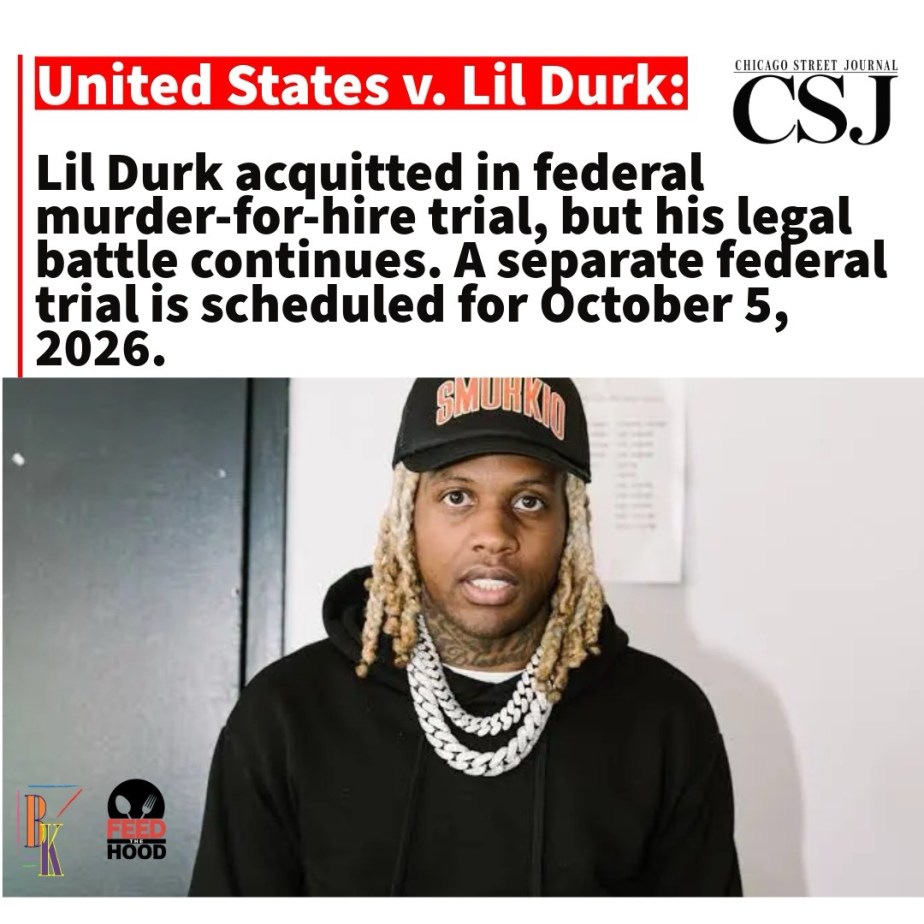
On September 11, 2026, a federal jury acquitted Durk Banks on all charges arising from the government’s prosecution of an alleged 2022 murder-for-hire plot targeting rapper Tyquian “Quando Rondo” Bowman.
Banks’s co-defendants Deandre “DeDe” Wilson and David “Browneyez” Lindsey were also acquitted of the murder-for-hire allegations, but the jury convicted Wilson and Lindsey of conspiracy to commit stalking, stalking with a dangerous weapon and stalking resulting in death. The jury deliberated for three days. (AP News)
That split verdict is significant.
The jury was willing to find criminal responsibility for portions of the underlying conduct while declining to find Banks guilty of the offenses charged against him.
The verdict does not establish that every government witness lied. It does not tell us that jurors accepted every defense argument. Nor does it establish that Banks knew nothing about the events surrounding the shooting.
It establishes something narrower and legally critical:
Federal prosecutors did not prove Banks guilty of the charged offenses beyond a reasonable doubt.
Understanding why requires looking past the headline and examining the structure of the government’s case.
I. STATEMENT OF FACTS
From King Von’s Death to the Los Angeles Shooting
The government’s case originated in the aftermath of the November 2020 killing of Chicago rapper Dayvon “King Von” Bennett.
Federal prosecutors alleged that Banks sought retaliation against Quando Rondo, whose associate was involved in the Atlanta confrontation that resulted in Bennett’s death.
Nearly two years later, on August 19, 2022, gunmen attacked Bowman’s group near the Beverly Center in Los Angeles.
Bowman survived.
His cousin, Saviay’a “Lul Pab” Robinson, was killed.
Prosecutors alleged that Banks orchestrated a murder-for-hire plot targeting Bowman and that people associated with his Only The Family organization traveled to California and participated in the operation.
Banks pleaded not guilty.
His defense maintained that Banks did not order the killing and sought instead to place responsibility for organizing the attack on his former assistant, Kavon “Vonnie” Grant.
After approximately two weeks of testimony and three days of deliberations, the jury acquitted Banks. (AP News)
That chronology establishes the background.
It does not, by itself, establish who ordered the attack.
That was the disputed question the government had to prove.
II. WHAT THE GOVERNMENT HAD TO PROVE
Understanding the verdict requires understanding the actual law.
Federal murder-for-hire is governed principally by 18 U.S.C. § 1958.
The Ninth Circuit’s model criminal jury instruction identifies three fundamental elements the government must prove beyond a reasonable doubt.
First, the defendant must use, cause another person to use, or conspire to use a facility in interstate or foreign commerce or engage in the corresponding interstate travel covered by the statute.
Second, the defendant must act with the intent that murder be committed.
Third, the defendant must intend that the murder occur in exchange for something of pecuniary value. (Ninth Circuit Court)
That third requirement deserves attention.
“Murder-for-hire” doesn’t necessarily require completed payment.
Under federal law, “pecuniary value” can encompass money, commercial interests or other things whose primary significance is economic advantage. Ninth Circuit authority also recognizes that a promise of economic advantage can qualify even when the promise isn’t legally enforceable. (Ninth Circuit Court)
Therefore, the simplistic argument:
“Nobody got paid, so there couldn’t have been murder-for-hire”
……is legally incomplete.
But the opposite shortcut is equally problematic.
The government still had to establish the required connection between the murder and the alleged economic bargain.
As the Ninth Circuit instruction explains, the defendant must clearly understand that the thing of economic value would be given or received in exchange for the murderous act. (Ninth Circuit Court)
In plain English:
Where was the bargain?
Who offered what?
To whom?
What was promised?
What evidence established the agreement?
And most importantly for Banks:
What evidence proved that Banks knowingly participated in that bargain?
Those questions bring us to the government’s witnesses.
III. THE GOVERNMENT’S THEORY
Prosecutors did not present the alleged conspiracy as one isolated conversation.
They assembled a circumstantial and testimonial case.
The government pointed to relationships among Banks and members or associates of OTF; interstate travel; lodging and transportation; financial resources; electronic communications; the movements of alleged participants; and testimony from people who admitted participating in the events surrounding the attack.
Prosecutors argued that these pieces formed one picture:
Banks wanted retaliation, supplied or enabled resources, and directed people around him toward killing Quando Rondo.
One of the government’s most consequential witnesses was Banks’s former assistant, Kavon Grant.
Grant admitted participating in the August 2022 attack and testified that he did so because:
“Durk told us to.”
That is direct testimonial evidence of the government’s theory, but it still depended on jurors believing Grant. (LA Magazine)
And Grant wasn’t the government’s only insider.
IV. THE DEFENSE THEORY
Banks’s lawyers did not need to prove who actually masterminded the shooting.
The burden remained with the government.
But the defense supplied jurors with an alternative explanation.
It portrayed Grant, not Banks, as the person responsible for organizing the attack and argued that cooperating witnesses had powerful incentives to transfer responsibility upward to Banks.
The defense attacked the credibility of witnesses who admitted criminal participation and subsequently cooperated with federal prosecutors.
That created a recurring evidentiary question:
When does insider testimony become proof, and when does it remain an accusation requiring stronger independent corroboration?
The prosecution could establish that an associate traveled.
It could establish that someone rented a vehicle.
It could establish that money changed hands.
It could establish that a cellphone traveled from one location to another.
But those facts still had to be connected to Banks’s intent and agreement to commit the particular crimes charged.
The government’s case therefore depended not simply upon proving events.
It depended upon proving what those events meant.
V. THREE INSIDERS
Three cooperating witnesses became especially important to understanding the prosecution:
- Kavon “Vonnie” Grant
- Kacey “OTF Jam” Hester
- Keith “Flacka” Jones
Their importance creates both strength and vulnerability for the government’s case.
An insider can provide information an outside witness could never know.
But cooperating witnesses may also face their own criminal exposure and potential sentencing consequences.
That doesn’t make their testimony inherently false.
It makes credibility, motive and corroboration especially important.
The jury ultimately heard the insiders’ accounts alongside the government’s independent evidence and the defense’s challenges to their credibility.
And then it acquitted Banks.
VI. THE FLACKA QUESTION: WHO IS KEITH JONES?
Keith Jones is particularly important because his position in the prosecution changed.
Jones, also known as “Flacka,” was not originally merely a witness against Banks.
He was a defendant.
He was charged in connection with the same alleged murder-for-hire scheme before later pleading guilty and becoming a government witness.
By the time of Banks’s trial, Jones was testifying for the prosecution about an operation in which he acknowledged participating. Courtroom reporting confirms that Jones testified immediately before Grant. (LA Magazine)
That history explains something that can look suspicious when documents from different stages of the prosecution are compared.
Jones can appear prominently among defendants in earlier case materials but not alongside Banks among the defendants whose guilt the September 2026 jury was deciding.
Based on the public evidence reviewed for this brief, that does not establish that Jones was secretly erased or “wiped” from the federal case.
His procedural status changed.
Defendant → guilty pleader → cooperating government witness.
That distinction is important enough that Chicago Street Journal is treating Jones’s plea and cooperation history as a separate reporting question rather than assuming what happened from changing document captions alone.
VII. THE $1 MILLION ALLEGATION
One allegation has traveled particularly far outside the courtroom:
Lil Durk allegedly placed a $1 million bounty on Quando Rondo.
But journalism requires us to ask:
Who actually heard what?
Jones’s testimony, as reported from the courtroom, was not simply that Banks personally approached Jones and offered him $1 million.
Reporting on the testimony describes Jones saying that Deandre “DeDe” Wilson told him Banks was offering $1 million for Quando Rondo’s killing. (XXL Mag)
The evidentiary chain being described is not simply:
Banks → Jones
It is:
Banks allegedly → Wilson allegedly → Jones.
Therefore, saying:
“Flacka testified that Durk personally offered him $1 million”
would overstate what Jones reportedly testified to.
The more precise formulation is:
Jones testified that Wilson told him Banks had offered a $1 million bounty.
Precision isn’t semantics here.
It’s evidence.
VIII. THE PAYMENT PROBLEM
Jones also testified about what happened after the attack.
According to courtroom reporting, Jones said he repeatedly sought compensation but Banks never paid him for his participation in the attempted attack. (XXL Mag)
Again, that does not automatically defeat a § 1958 prosecution.
Federal murder-for-hire law can encompass a promise or agreement involving economic value even if the promised benefit isn’t ultimately delivered. (Ninth Circuit Court)
But it creates an obvious evidentiary question:
If this was murder-for-hire, what evidence establishes the hire?
The prosecution didn’t necessarily need a canceled check marked “Quando hit.”
Criminal conspiracies rarely arrive gift-wrapped.
But prosecutors still needed evidence from which jurors could find the required economic agreement beyond a reasonable doubt, and Banks’s participation in it.
That makes the absence of a completed payment only part of the story.
The larger issue is whether the testimony, communications, money and other evidence sufficiently established the bargain itself.
IX. WHAT WAS CORROBORATED?
This may be the most important question in the entire case.
Strip away conclusions for a moment.
The government had evidence capable of establishing significant surrounding events and relationships.
It also had participants willing to tell jurors what they said those events meant.
But those are two different categories of evidence.
Suppose independent records establish that Person A flew from Chicago to Los Angeles.
That proves travel.
Suppose financial records establish that Person B paid for a hotel.
That proves a financial transaction.
Suppose cellphone data places Person C near a particular location.
That can establish location.
But none of those facts automatically answers:
Who ordered a murder?
The prosecution’s cooperators supplied crucial connective tissue.
Grant supplied perhaps the most direct version when he testified:
“Durk told us to.” (LA Magazine)
The defense consequently had an obvious strategic target:
the credibility of the people supplying the connection between Banks and the crime.
That’s why this case cannot be understood merely by counting how many pieces of evidence prosecutors introduced.
The better question is:
Which pieces independently established Banks’s criminal intent, and which pieces acquired their incriminating meaning primarily through a cooperating witness’s interpretation?
That question deserves a document-by-document examination.
X. THE VERDICT
On September 11, the jury returned its answer to the charges.
Banks was acquitted on all counts.
Wilson and Lindsey were acquitted of the murder-for-hire-related charges but convicted of conspiracy to commit stalking, stalking with a dangerous weapon and stalking resulting in death. (AP News)
The split verdict is worth studying.
Jurors were plainly capable of convicting defendants before them.
They did.
But they did not convict Banks.
That does not permit us to reverse-engineer the jury room and declare exactly which witness jurors believed or disbelieved.
A general verdict doesn’t provide that information.
What we can say is:
After hearing the government’s evidence and the defense’s challenges, the jury concluded that prosecutors had not proven Banks guilty of the charged offenses beyond a reasonable doubt.
Anything more specific requires evidence of the jurors’ reasoning that we presently do not have.
XI. WHAT THE VERDICT DOES NOT MEAN
This matters because criminal verdicts routinely get flattened on social media.
Not guilty does not mean “the jury proved he was innocent.”
The defendant doesn’t carry the burden of proving innocence.
The government carries the burden of proving guilt.
Likewise, the acquittal does not establish:
that every cooperator lied;
that every government allegation was fabricated;
that nothing criminal happened;
or
that everyone surrounding Banks was innocent.
In fact, the same jury convicted Wilson and Lindsey on stalking-related offenses. (AP News)
The legally accurate conclusion is considerably simpler:
The government did not prove its charges against Banks beyond a reasonable doubt.
XII. THE QUESTION AFTER THE ACQUITTAL
The verdict leaves us with a better journalistic question than:
“Did Durk do it?”
The question is:
Where did the government’s evidentiary bridge fail?
Was it cooperating-witness credibility?
Was it insufficient independent evidence establishing who gave the alleged order?
Was the million-dollar allegation too dependent upon communications passed through other people?
Did the financial evidence establish spending without sufficiently establishing a murder-for-hire bargain?
Could prosecutors establish the actions of the participants without proving Banks knowingly joined their criminal agreement?
Did jurors accept some government evidence but reject the inference prosecutors wanted them to draw from it?
Or did several of these problems converge?
The verdict itself doesn’t tell us.
The record might.
XIII. HIP-HOP ON TRIAL
There is another story underneath United States v. Banks.
It concerns what happens when hip-hop culture enters a federal courtroom.
Relationships become evidence.
Lyrics can become evidence.
Slang becomes something lawyers ask jurors to interpret.
Record-label and entourage finances can become potential evidence.
Travel becomes evidence.
Social-media posts become evidence.
The actions of employees, friends and associates can become evidence offered against an artist alleged to occupy a leadership position.
None of those categories is automatically legitimate or illegitimate evidence.
The journalistic responsibility is to distinguish between:
what the evidence objectively establishes
and
the interpretation prosecutors or defense attorneys ask a jury to place upon it.
That’s particularly important when jurors may not share the cultural vocabulary of the people whose communications they’re evaluating.
A lyric can have meaning.
A slang term can have meaning.
An artist paying an associate’s expenses can have meaning.
But determining what those things prove in a criminal prosecution requires considerably more than recognizing that they sound suspicious.
There is a difference between cultural interpretation and legal proof.
This case sits directly at that intersection.
XIV. LEGAL TERMS IN PLAIN ENGLISH
Indictment
A formal criminal accusation returned by a grand jury. An indictment states what prosecutors allege. It is not evidence that the allegations are true.
Superseding Indictment
A replacement indictment. Prosecutors may use one to add, remove or modify defendants, charges or factual allegations.
Defendant
A person formally accused of a crime in the case.
Co-defendant
Another person charged in the same prosecution or related proceeding.
Cooperating Witness / Cooperator
Someone who provides information or testimony to prosecutors. Cooperators are sometimes themselves charged with crimes and may hope their assistance will be considered when they’re sentenced.
Cooperation does not automatically make testimony true or false.
Plea Agreement
An agreement under which a defendant agrees to plead guilty under specified terms. Some plea agreements also contain cooperation obligations.
Conspiracy
In general terms, an agreement between people to commit a criminal offense.
A defendant doesn’t necessarily have to personally perform every act of the underlying crime to face conspiracy liability. But mere friendship or association with someone who commits a crime isn’t itself enough to establish participation in a conspiracy.
Murder-for-Hire | 18 U.S.C. § 1958
The federal offense at the center of this prosecution.
Under the Ninth Circuit model instruction, prosecutors must establish the required interstate-commerce component, intent that murder be committed, and intent that the murder occur in exchange for something of pecuniary value. (Ninth Circuit Court)
Pecuniary Value
Something primarily carrying economic value or advantage.
That can include money, commercial interests and other economically valuable benefits. (Ninth Circuit Court)
Quid Pro Quo
Literally, “something for something.”
In the murder-for-hire context, the important concept is an exchange: the economic benefit is connected to the requested murder rather than being unrelated generosity or ordinary financial activity.
Direct Evidence
Evidence that directly addresses a fact if believed.
Grant’s testimony that “Durk told us to,” for example, directly alleges an instruction. (LA Magazine)
Whether a jury believes the witness is a separate question.
Circumstantial Evidence
Evidence from which another fact can reasonably be inferred.
Travel records, location data and financial transactions can all be circumstantial evidence.
Circumstantial evidence is not automatically inferior to direct evidence.
Corroboration
Independent evidence supporting another piece of evidence or a witness’s account.
If a cooperator says a defendant gave an order, an independently authenticated message expressing that same order could potentially corroborate the testimony.
Hearsay
Generally, an out-of-court statement offered to prove the truth of what it asserts.
But “hearsay” does not automatically mean inadmissible. Federal evidence law contains numerous exclusions and exceptions, including rules that can apply to statements made during and in furtherance of a conspiracy.
Impeachment
Evidence or questioning used to challenge a witness’s credibility.
Prior inconsistent statements, certain biases, motives and other credibility issues can become subjects of impeachment.
Cross-Examination
Questioning of a witness by the opposing side.
Cross-examination allows lawyers to challenge what the witness remembers, whether accounts have changed and whether the witness has motives affecting credibility.
Beyond a Reasonable Doubt
The government’s burden of proof in a criminal prosecution.
The government must establish every required element of an offense beyond a reasonable doubt.
The defendant does not have to prove innocence.
Acquittal / Not Guilty
A verdict finding that the government did not prove the defendant guilty beyond a reasonable doubt.
It is therefore incorrect to automatically translate an acquittal into a factual finding about everything that did or did not happen.
Split Verdict
A verdict in which jurors reach different conclusions on different defendants or charges.
That’s what happened here: Banks was acquitted, while Wilson and Lindsey were acquitted of murder-for-hire-related allegations but convicted of stalking-related offenses. (AP News)
Severance
The separation of defendants or charges into different trials.
Banks remains in federal custody following this acquittal because he faces a separate trial currently scheduled for October 5 involving murder-related racketeering and weapons allegations. Those remain allegations, and Banks remains presumed innocent of them unless proven guilty. (MarketScreener)
XV. WHAT COMES NEXT
The September 11 acquittal closes one chapter of Banks’s federal prosecution.
It does not end the broader federal case.
Banks remains in custody and, according to the U.S. Attorney’s Office information reported following the verdict, faces another trial scheduled for October 5 on separate murder-related racketeering and weapons charges. (MarketScreener)
For Chicago Street Journal, however, the work on this first trial isn’t finished.
The next phase is the record.
We are examining:
the indictments;
Keith Jones’s plea and transition from defendant to cooperating witness;
the cooperation agreements;
trial and evidentiary briefs;
jury instructions;
the alleged $1 million bounty;
financial records and alleged payments;
travel and lodging evidence;
cellphone and electronic evidence;
witness testimony and impeachment;
and the evidence that independently corroborated, or failed to corroborate, the government’s cooperators.
The objective isn’t to retry Durk Banks in the press.
It is to understand how one of the most consequential federal prosecutions involving a Chicago hip-hop artist was constructed, and why that prosecution did not produce a conviction against him.
Because an allegation isn’t evidence.
Evidence isn’t automatically proof.
And evidence itself can be undisputed while its meaning remains fiercely contested.
The jury has delivered its verdict.
Now we’re going into the documents.
PRIMARY LAW & SOURCE RECORD
U.S. Court of Appeals for the Ninth Circuit – Model Criminal Jury Instruction 16.7, Murder for Hire (18 U.S.C. § 1958). Defines the elements prosecutors must establish and explains “pecuniary value.” (Ninth Circuit Court)
Associated Press – September 11, 2026. Contemporary verdict reporting confirming Banks’s acquittal, the three-day deliberation and Wilson and Lindsey’s stalking convictions. (AP News)
Reuters – September 11, 2026. Independent verdict reporting and confirmation that Banks remains detained pending the separately scheduled October prosecution. (MarketScreener)
Los Angeles Times – September 11, 2026. Courtroom reporting describing the competing prosecution and defense theories and the verdict. (Los Angeles Times)
Los Angeles Magazine – August 31, 2026. Courtroom reporting documenting Kavon Grant’s testimony concerning his participation and his allegation that Banks directed the group. (LA Magazine)
XXL – August 31, 2026. Courtroom reporting concerning Keith Jones’s testimony about the alleged bounty and his claimed attempts to obtain payment. Because these details presently rely on secondary courtroom reporting rather than a certified transcript in this brief, they are attributed accordingly. (XXL Mag)
Editorial Note
This brief distinguishes allegations, witness testimony, attorney arguments and established outcomes. Statements attributed to cooperating witnesses are their testimony, not independent findings by Chicago Street Journal. The September 11 verdict establishes that Banks was acquitted of the charges tried before this jury; it does not independently resolve every disputed factual question raised during the prosecution.
Banks remains in federal custody pending a separate federal trial currently scheduled for October 5, 2026, involving severed murder-related racketeering and weapons charges. Those allegations were not decided by the September jury, and Banks remains presumed innocent of them unless and until the government proves them beyond a reasonable doubt.
Chicago Street Journal will continue reviewing the court record and following developments in the upcoming prosecution.