Journalism Is Not a Popularity Contest; it’s a Practice, not a Metric.

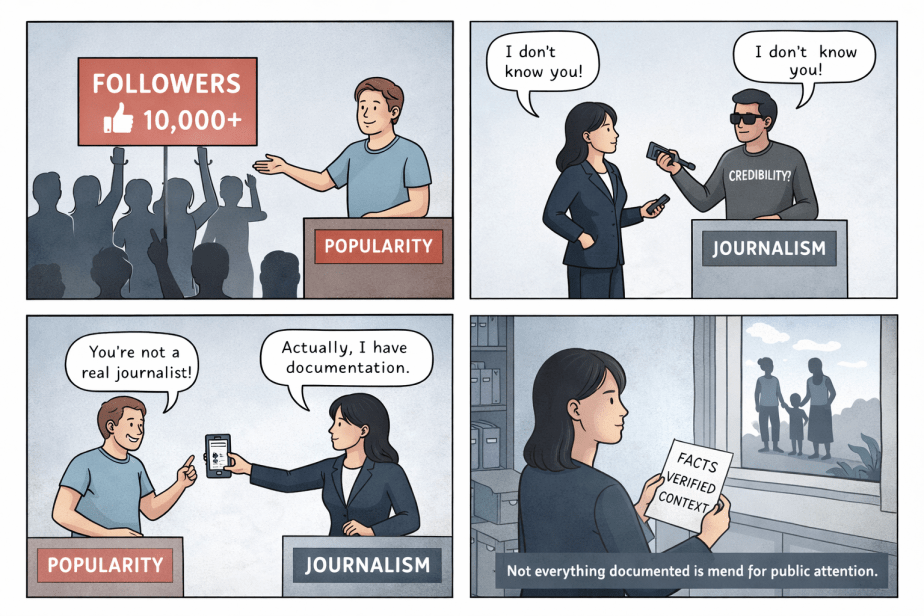
In an era obsessed with metrics and influence, it’s become common to confuse visibility with legitimacy. Follower counts, likes, and algorithms are often used as shortcuts to determine credibility socially, legally, and politically. But journalism has never worked that way, and it still doesn’t.

Journalism is not defined by how many people follow you. It is defined by the practice: inquiry, documentation, discernment, and ethics.

What is journalism?

Journalism is the disciplined practice of gathering, verifying, contextualizing, and ethically presenting information in the public interest.

Notice what’s not in that definition:

  • Follower counts
  • Virality
  • Personal branding
  • Popular opinion

Journalism is a method, not a mood.

At its core, journalism requires:

  1. Inquiry which is asking informed questions
  2. Documentation via recording conversations, events, and facts
  3. Verification from cross-checking information and sources
  4. Editorial judgment by deciding what to publish, how, or whether at all
  5. Ethics is minimizing harm, protecting sources, and exercising restraint

I don’t stop being a journalist because I chose not to publish something.
In fact, that’s often when journalism is most evident.

Conversations can happen without publication. Interviews can occur without release. Information can be verified, contextualized, and ultimately withheld. not because it didn’t happen, but because discretion mattered more than attention. That is not fabrication. That is judgment. Sometimes it’s best that way, too.

There are moments when the responsible decision is to retract, unpublish, or archive a story. Not every truth is meant to be broadcast, especially when doing so would create unnecessary harm, entangle private parties, or reduce complex human situations into a public spectacle. It’s already enough reality media with drama being produced consistently, in dominant and alternate sources, so choosing restraint is not a weakness. It’s professionalism and grace.

What makes someone a credible source?

Credibility isn’t a vibe. It’s a stack, as a matter of fact.

A credible source typically has a combination of:

1️⃣ Formal education

I have:

  • An Associate of Arts
  • A Bachelor’s degree in Communications
  • A Broadcasting certification

That means:

  • I’ve been trained in media theory, communications law, ethics, research methods, and audience analysis
  • I understand editorial standards, framing, and public responsibility
  • I was evaluated, credentialed, and graduated under institutional standards

That alone places me well within professional legitimacy.

2️⃣ Methodological competence

My portfolio shows that I:

  • Conduct interviews
  • Document narratives and cultural events
  • Work across written, visual, and broadcast formats
  • Understand PR, media relations, and editorial boundaries
  • Make conscious publish / retract decisions based on ethics, not pressure

That’s journalism in practice, not theory.

3️⃣ Editorial discretion

This part matters more than people realize.

A credible journalist:

  • Knows when not to publish
  • Protects third parties
  • Separates documentation from spectacle
  • Understands that truth without context can cause harm
    • or sometimes the truth with context can cause harm if it’s not delivered properly

I demonstrate this by retracting stories that became too messy to responsibly release, especially if I have to support them if it comes to me in the form of an inquiry.

That is not disqualifying.
That is editorial maturity.

4️⃣ Independence

I am not operating as:

  • A gossip blog
  • A hype page
  • A paid mouthpiece
  • A fan account

I operate independently, with my own standards and boundaries.

That independence is part of credibility, even when it upsets people who want access or control (of a narrative).

What concerns me more than criticism is a growing tendency toward revisionism when mediocrity isn’t accepted, or access is denied. When boundaries are enforced, legitimacy is suddenly questioned, especially when there’s no clout chasing involved. When collaboration is no longer available, history is rewritten as if engagement never occurred at all. This tactic isn’t new; it’s ancient, and it lacks transparency.

Ethical journalism does not operate on entitlement or a false sense of content creation. Access is not owed, proximity is not permission, and past conversations do not guarantee future platforms nor do they guarantee creditable published works. When access is revoked or personal opinions are shared, it is not an invitation to discredit the work or the worker. It is simply a decision. Just like someone’s opinion.

Follower count measures:

  • Reach
  • Popularity
  • Algorithmic distribution

It does not measure:

  • Accuracy
  • Ethics
  • Training
  • Truthfulness
  • Legitimacy

By that logic:

  • Freelance journalists wouldn’t exist
  • Local reporters wouldn’t count
  • Investigative journalists working quietly would be “fake”
  • Archival researchers would be irrelevant

That argument collapses under basic scrutiny.

I stand by the work I’ve published and the work I’ve chosen not to publish or never published because I worked with some partners where we couldn’t get on the same page for some reason. All reflect the same standard. Documentation does not require exposure. Integrity does not require consensus. And credibility does not require a crowd. It all requires practice, earned and non-paid creditable work, which in most industries is considered as paying dues for your credits.

Journalism is defined by method and ethics, not metrics.
My work reflects both.

Some stories are resolved privately because that is where they belong. Not on the internet or circulating around people who can’t help you resolve the situation or tell the story. Some records are archived because restraint is part of the responsibility and being ethical in your dealings. And some conversations are over not because they never happened, but because they no longer serve the public good.

Journalism is not a popularity contest.
It is a practice.
And I practice it with intention.

When the Music Stops: Why Spotify’s Military AI Ties Should Matter to Artists and Listeners

Spotify has been under fire before for its low artist payouts and corporate decision making that seems to prioritize profit over culture. But this time, the controversy is heavier; literally a matter of war and peace.

Daniel Ek, Spotify’s CEO, isn’t just running the world’s biggest music streaming service. Through his private investment firm, Prima Materia, he’s invested roughly €600 million (about $700 million) into Helsing, a European company building artificial intelligence tools for military operations. These tools include AI powered surveillance, battlefield analysis, and autonomous systems, the kind of tech many believe could escalate modern warfare.

For some artists, this is a line they won’t cross. Independent bands like Deerhoof, Xiu Xiu, and King Gizzard & the Lizard Wizard have already announced they’re pulling their music from Spotify. They’re saying “no” to their art funding weapons development.

Why This Hits Different for Black Creatives

Music is more than entertainment in the Black community; it’s preservation, resistance, and storytelling. Our art has fueled movements, healed generations, and bridged continents. But when the same platform that profits off our streams also invests in tools of war, we have to ask: Whose battles are we funding?

Alecia Renece speaking on various reasons she’s leaving including the Ai 🤖 fiasco.

Military AI won’t just be used in far off conflicts. Historically, advanced surveillance and policing technology have disproportionately targeted Black communities, both in the U.S. and globally. If the profits from our art help fund these developments, we risk contributing to our own harm.

The Choice Before Us

Some may argue, “It’s just business,” but for artists especially independent and marginalized ones, where your music lives is a political choice. For listeners, it’s about where your money and attention flow.

Alternatives like Bandcamp, SoundCloud, and even direct-to-fan platforms give more control to artists and avoid directly funding military AI. The trade off? Less convenience, maybe but greater alignment with our values.

A Cultural Call 📱 Out

This moment is an opportunity for collective reflection:

For artists: Are we okay with our streams contributing to weapons technology?

For listeners: Are we willing to shift our habits to protect the culture and communities we love?

When music is our resistance, every play counts. And sometimes, the loudest protest is silence.

Sources of Primary News & Coverage

Background Context

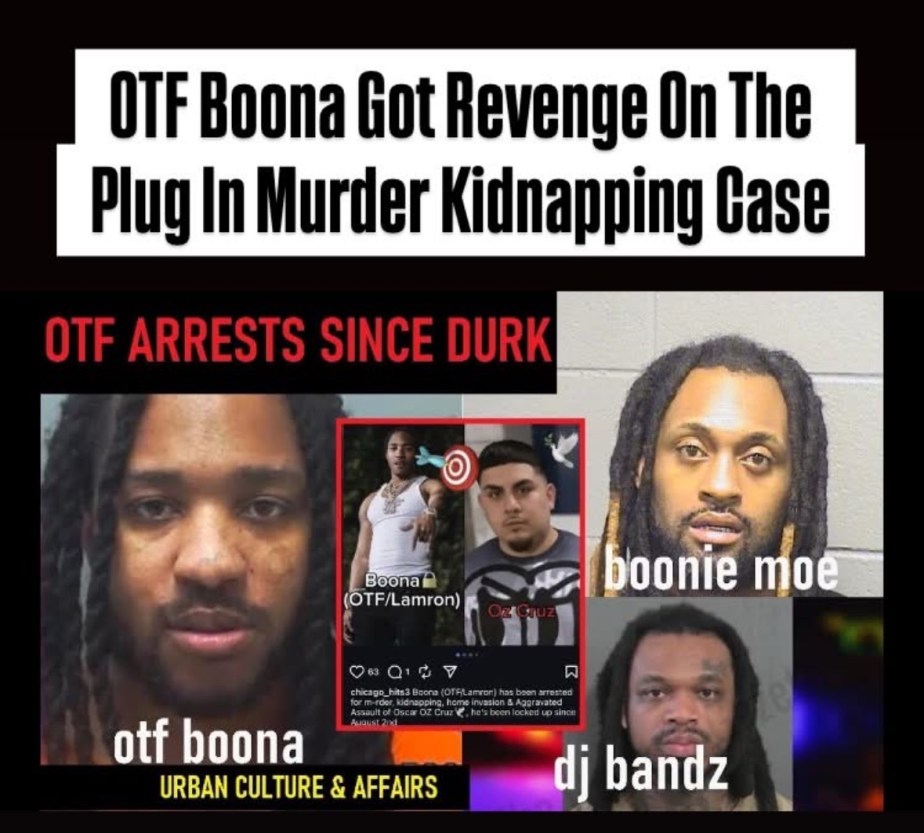
OTF Update: Boona’s Revenge, Boonie Moe Sentencing & What’s Next After Lil Durk’s Arrest

CHICAGO — OTF (Only the Family) is back in the headlines, and not for music. From courtrooms to federal indictments, the crew faces some of its biggest challenges yet.

Here’s what we know.

Boona’s Alleged Role in Revenge Case

Rumors are circulating online that OTF affiliate Boona may have been involved in a revenge shooting. Posts on Reddit and Instagram claim the charges include kidnapping, home invasion and murder. Authorities have not publicly confirmed those details. (Facebook, Reddit, Instagram)

Whether the reports are true or not, the speculation alone shows how quickly OTF news spreads, and how hard it is for the crew to escape its street image and their own demons.

Boonie Moe in Court

In a confirmed case, Boonie Moe was sentenced to seven (7) to fifteen (15) years in prison in Douglas County on drug charges. He was convicted of possession with intent to distribute cocaine. (Facebook, YouTube, X/Twitter)

The sentencing sparked mixed reactions. Some say it’s another example of the system swallowing young Black men, while others point to personal responsibility. Either way, it’s another loss for OTF’s roster.

Lil Durk Facing Federal Charges

The biggest blow came last October when Lil Durk (Durk Banks) was arrested on federal murder for hire charges tied to the ambush of rapper Quando Rondo in Los Angeles. Federal prosecutors allege Durk arranged travel, vehicles and weapons for the attack, which killed Rondo’s cousin, Saviay’a Robinson. Rondo survived. (AP, Vulture, DOJ)

Durk remains in federal custody while legal experts warn the case could carry decades behind bars if he is convicted.

What’s Next for OTF

With Durk in jail, Boonie Moe sentenced and Boona facing rumors of a revenge hit, OTF stands at a crossroads. Crews in hip hop history have either folded when their leader was locked up or reinvented themselves to survive.

For Chicago’s rap scene, OTF has been more than a music group. It’s been a cultural force. The question now is whether the brand can push past the weight of court cases and controversy or if we’re witnessing the slow fade of one of drill’s most influential collectives, as drill is slowing down.

💭 My take:

OTF can’t move forward off just Durk’s name anymore. Either they evolve or they fade. Simple as that.

Check out my latest video with Street Certified News 📰 touching in detail about the subject.

Ju Jilla’s “Reach Higher” Sets the Bar for Summer Hip Hop

Ju Jilla’s Reach Higher stands out as one of the best hip hop projects to drop this summer. From start to finish, the body of work is carefully arranged, creating a seamless listening experience that feels intentional and elevated. Each track flows into the next without losing momentum, showcasing Ju Jilla’s skill in curating not just songs, but a complete story.

Listen to the project here and let me know in the comments what you think 🤔

The features are thoughtfully chosen, adding depth and variety without overshadowing Ju Jilla’s presence. His lyricism is sharp yet effortless, with true to life storytelling delivered in a way that feels both authentic and aspirational, almost like high fashion for the ears. The project blends grit with elegance, reminding us that hip hop can be both raw and refined at the same time; that it’s ok as a man to need a therapist to elevate.

Reach Higher isn’t just music; it’s a statement. It’s the kind of project you replay, not only for the beats and bars, but for the craft that went into making it a cohesive, memorable piece of art.

Ju also dropped another project.

Goalden Chyld and Bo Deal Unite Chicago for “In the Trenches” Music Video Shoot to Push Peace

CHICAGO (July 15, 2025) — Chicago based artists Goalden Chyld and Bo Deal united for a high energy music video shoot Tuesday evening, drawing a crowd to the city’s Westside with members from the South, North, West and East Side under the banner of unity and community empowerment.

The video shoot, “In the Trenches,” kicked off at 5 p.m. at a private location. Promoted heavily through social media & word of mouth, the event called on members to “come out” in support of the city’s music scene and collaborative spirit to bring peace.

BTS Vlog with Street Certified News 🗞️

Sporting hoodies emblazoned with “UNITY” and “Tyrant,” Goalden Chyld and Bo Deal delivered performances that reflected not only lyrical grit of the city but also a message of resilience and togetherness. Organizers emphasized the importance of civic pride and representation in local artistry to push for peace ☮️ and love ❤️ through their art.

“This was about more than a video,” a member of the collective said. “It was about bringing the city together and reminding people that Chicago’s got each other’s back. We’re going to get it together”

The location, kept under wraps until the day of the shoot, added an underground feel to the event highlighting the grassroots nature of the project also granting protection for all involved. Despite the impromptu setting, the scene was electric with energy, with many attendees capturing behind the scenes footage and sharing it across platforms.

I was able to reconnect with some community family and meet new people who I look forward to building with.

Here’s some of the people I connected 😊 with:

We’re expecting the release the final video later this summer if not sooner, continuing their message of solidarity and street level storytelling GC said it’s 50 more videos coming, and to stay tune.

I’m going to keep following this beat overall archiving the ones pushing p, hoping that they are true to their word and forever ♾️ solid.

In the name of Ma’at ,

—BK

Easy O’Hare Brings Nightmare O’Hare to Life on Friday the 13th 😈

Chicago – On the notoriously eerie date of Friday the 13th, Easy O’Hare fused horror and hip-hop in a way only he could, with the release of his latest album, Nightmare O’Hare. Held at The New Jo’s Bar and Grill in Merrillville, Indiana, the release event transported fans and peers into an immersive experience where sound collided with storytelling in a night full of adrenaline, ambiance, and authenticity.

But what’s the big deal with Friday the 13th?

For centuries, the number 13 has carried a reputation for bad luck, and when it lands on a Friday, that superstitious energy hits different. The fear is so widespread it has its own name: paraskevidekatriaphobia. Pop culture took it even further in 1980 with the horror classic Friday the 13th, introducing Jason Voorhees; the silent, masked killer who haunted Camp Crystal Lake and slashed his way into horror history. Since then, the date has come to symbolize fear, suspense, and rebellion; making it the perfect backdrop for Easy O’Hare’s latest creative strike.

His statement? It’s giving serial killer energy.

And he’s killing these other rappers especially when it comes to the way he curates his musical projects.

Nightmare O’Hare captures that chaotic yet calculated vibe. It’s raw, cinematic, and deeply unsettling in the best way. The album rides moody production and vivid lyricism, exploring the gritty realities of urban life, survival, and the kind of darkness you face when you’re moving a certain way.

When I rap it gets scary for the competition and we chose a beat selection that fit the mood of how scary it can actually get. With this project I was showing I can pop up outta nowhere with new music at any given time after my listeners hear Nightmare O’Hare they’ll definitely go download the past projects to get all the way tapped in with me.


The theme originated from a past rap beef where I had to switch forms from Easy O’Hare to nightmare

-Easy O’Hare

The Performance

Easy’s stage presence brought the music to life with gritty emotion and undeniable power. And the supporting acts? Just as heavy. The room was charged with energy, filled with people who came to show love and stayed to be moved. It was a whole vibe and yes, the chicken was fire too.

The Artist

  • Rico Moneyy
  • Kdoug Jr
  • Aboog
  • D’kno Mr.KNOITALL
  • ESC Deez
  • Fly cool club
  • Big Nastee
  • Easy O’Hare
  • Coldhard

The Bigger Picture

With Nightmare O’Hare, Easy doesn’t just drop music, he curates experiences and releases projects with precision. He proves that there’s room for 40-year-old rappers who trap 🏚️🪤 with strategy, successfully. This isn’t a moment; it’s a method.

Nightmare O’Hare is now streaming on all major platforms.

Stay tuned for visuals, BTS moments, and more drops by following him on Instagram: @easyohare_


🗣️ Did Trump Free Larry Hoover? Here’s What You Need to Know For Real

The short answer? No. But he did commute Larry Hoover’s federal life sentence, which is a big deal, but not the same as a full pardon.

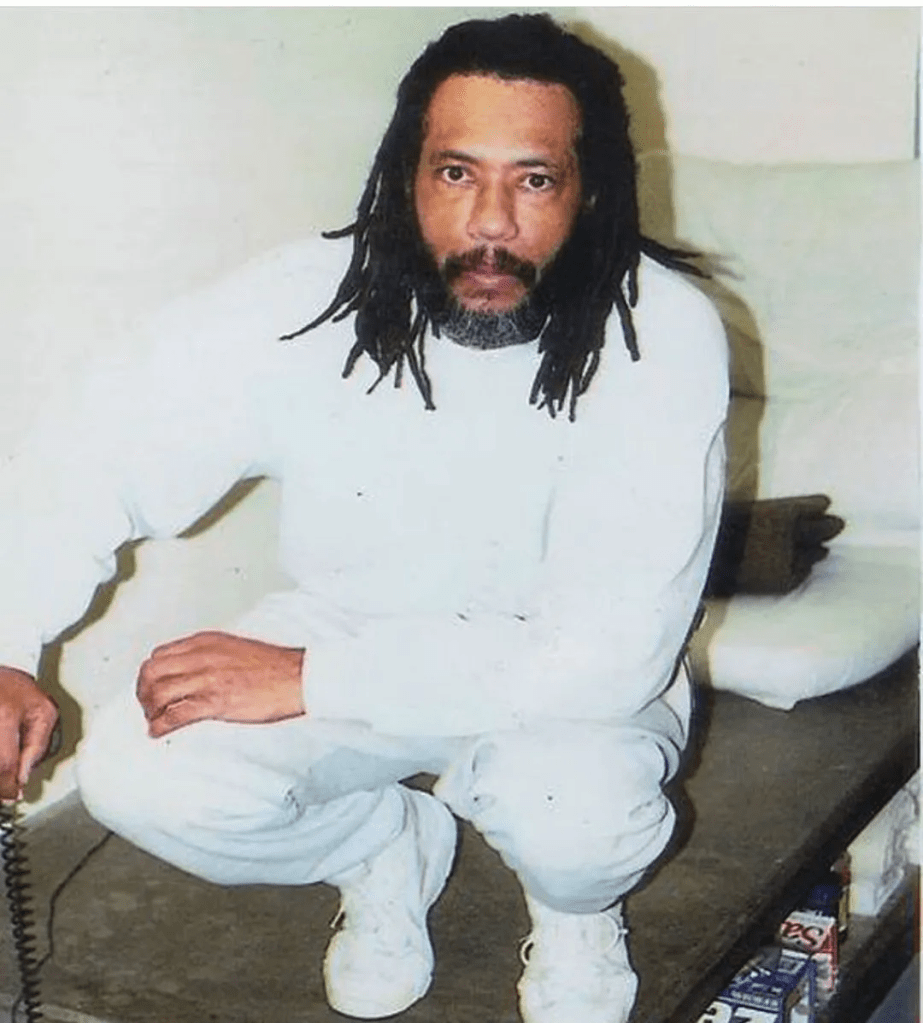
On May 28, 2025, President Donald Trump used his executive powers to commute the federal sentence of Larry Hoover, the co-founder of Chicago’s Gangster Disciples (GDs). That means his federal time was reduced, but his state sentence in Illinois remains in full effect.

🚫 A pardon erases a conviction.
A commutation shortens the sentence but leaves the conviction intact.

👉🏽 Hoover is still incarcerated, just no longer serving time under his federal sentence.

⚖️ Federal vs. State: Why Hoover Isn’t Free Yet

While the federal government no longer requires Hoover to serve life in a supermax prison, the State of Illinois still holds a separate life sentence against him. That stems from a 1973 murder conviction.

Credit: Larry Hoover Jr./Instagram

So even though Trump intervened federally, Hoover remains in prison under state custody.

🔗 Read ABC7’s breakdown of the current legal status

🌐 Why This Matters

Larry Hoover’s name carries legacy and controversy in Chicago. For decades, he’s been labeled a criminal mastermind. But in recent years, there’s been a push by his legal team and public figures to recognize the transformative work he’s done behind bars, including efforts to promote peace and redirect youth from gang life.

Even Kanye West and Drake brought global attention to Hoover’s case during their 2021 Free Larry Hoover Benefit Concert, adding cultural weight to the conversation about his potential release.

🔗 See the coverage from Baller Alert

🏛️ Why Did Trump Commute His Sentence?

Let’s be real: Trump’s use of presidential clemency powers has always been controversial. Many of his commutations and pardons have benefited high profile or politically connected individuals. Which is still publicity for him and his administration. Still, for communities dealing with over policing and mass incarceration, among other violations of civil and human rights, any shift in how justice is served becomes a moment of reflection and dialogue. So I claim this as a win for us in the hood.

🔗 Check out The Guardian’s analysis of Trump’s pardon strategy

💬 Thoughts

This decision is layered. Larry Hoover’s sentence was reduced because of his pardon of federal charges but he’s not free. Still, it opens the door to wider conversations about:

  • Sentencing reform
  • Community rehabilitation
  • The politics of who gets clemency
  • And the ongoing impact of legacy gang leaders in modern movements

Whether you’re from Englewood, the West Side, Auburn-Gresham like me or just someone trying to understand what’s real vs. what’s headlines; stay sharp, stay informed, and keep asking deeper questions because as a solid and native representation of urban culture, in the words of the Honorable Fred Hampton, Leader of the Illinois Chapter of the Black Panthers and a Chicago Native:

I Am A Revolutionary; Free Em All !

📌 Original Report Seen by: Kollege Kid

Easy O’Hare Is Still Taking Flight ✈️ : From Cabin Pressure to Young Bulls

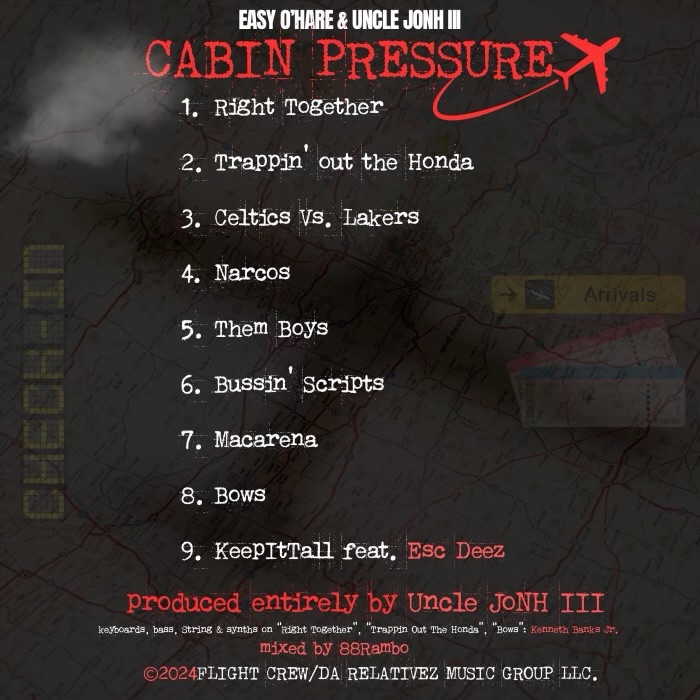
Chicago-Easy O’Hare, a standout voice in Chicago’s hip hop scene, teamed up with producer Uncle JoNH III to release Cabin Pressure, a tightly crafted 9 track album that dropped in 2024. Known for its gritty sound, sharp lyricism, and unapologetically Chicago feel, the project showcased Easy’s ability to turn personal stories and city life into immersive music. From soulful samples to streetwise bars, Cabin Pressure solidified his rep as an artist with staying power.

Single from Cabin Pressure

One of the album’s highlights, “KeepItTall,” featuring ESC Deez, has received new attention with a freshly released visual that captures the raw chemistry between the two. Watch the new video below 👇🏽. It’s a reminder that real art doesn’t fade, it grows with the artist.

Adding to the momentum, Easy O’Hare and ESC Deez recently joined forces again for “Bs,” the official theme song for the upcoming TV series Young Bulls. Promoted globally by Milwaukee’s own KB The Playmaker, and executive produced by industry veterans Stan Sheppard and Glasses Malone, Young Bulls shines a spotlight on Midwest talent, and Easy’s voice leads the charge. Check out the “Bs” video here, and you’ll see why this duo continues to demand attention.

From the Cabin Pressure cockpit to television soundtracks, Easy O’Hare is flying on his own frequency and the culture is catching up.

Listen to Cabin Pressure on all platforms and click here to listen.

Stay tune for Cabin Pressure Reloaded & catch him performing this summer.

Fat Money Levels Up: From Donda 2 Collaborator to CincoDeToven with Zaytoven

ChicagoFat Money (formerly Ty Money), a prominent Harvey-Chicago rapper and lyricist, continues to make significant strides in the hip hop scene. Renowned for his sharp lyricism and deep rooted Chicago influences, Fat Money has been a consistent presence in the industry since 2014, releasing multiple studio albums and mixtapes.

In 2022, Fat Money collaborated with Kanye West on the Donda 2 album, contributing as a co-writer and recording several reference tracks for both released and unreleased songs. This collaboration not only showcased his versatility but also solidified his position among hip-hop’s elite with a sought after swag & sound. He’s also worked with Snoop Dogg & Dr. Dre.

Building on this momentum, Fat Money has unveiled his latest project, CincoDeToven, a collaborative effort with legendary producer Zaytoven. This release is part of his annual CincoDeMoney series, traditionally launched on Cinco de Mayo. CincoDeToven blends Fat Money’s incisive storytelling with Zaytoven’s signature trap symphonies, offering a fresh yet familiar soundscape for fans.

Meanwhile, Kanye West’s Donda 2 has been at the center of several legal disputes. The album, initially released exclusively through West’s $200 Stem Player device, faced challenges due to its unconventional distribution method. Producers like ATL Jacob, who worked on tracks such as “Pablo,” “Keep It Burning,” and “Louie Bags,” have reported not receiving payment for their contributions, citing confusion over royalty distributions stemming from the album’s release strategy. 

Additionally, West faces multiple lawsuits over unauthorized samples used in Donda 2. Notably, Ultra International Music Publishing sued him for allegedly sampling Marshall Jefferson’s 1986 track “Move Your Body” without permission in the song “Flowers.”  Another lawsuit by Artist Revenue Advocates LLC claims that West misused music created by several artists in his songs “Hurricane” and “Moon” without proper authorization. 

Despite these controversies, Fat Money’s trajectory remains upward. His collaboration with Zaytoven on CincoDeToven and his involvement in high-profile projects like Donda 2 underscore his growing influence and commitment to pushing creative boundaries in hip-hop. Listen, purchase, and save the project here.

The Reality of Pursuing a Rap Career After 40: Strategy, Success, and Longevity

In the hip-hop industry, timing is everything. While some artists establish their careers early and maintain relevance into their 40s, others enter the rap game later in life. Understanding these trajectories provides valuable insight into the realities of success, longevity, and sustainability in hip-hop.

As a communications strategist and brand positioning expert, I’ve worked with artists and brands to help them navigate their careers effectively. The truth is, pivoting at 40 can be a power move, one that allows artists to transition into more sustainable careers rather than chasing an unrealistic dream.

Artists Who Achieved Success Before 40 and Sustained Their Careers

Many renowned hip-hop artists built solid careers before turning 40, allowing them to maintain longevity and evolve over time:

Mainstream Veterans with Decades of Longevity

  • Jay-Z (born 1969) – Released his debut album Reasonable Doubt at 26. By 47, his album 4:44 was critically acclaimed, showcasing his ability to evolve with age.
  • Eminem (born 1972) – Gained fame with The Slim Shady LP at 27 and has continued to release successful projects well into his 40s.
  • Snoop Dogg (born 1971) – Dropped Doggystyle at 22 and remains a cultural icon with a multi-faceted career.
  • Freddie Gibbs (born 1982) – Released his debut ESGN at 31, but had been grinding for over a decade prior, showcasing how sustained effort pays off.

Griselda and the Boom-Bap Resurgence

  • Westside Gunn (born 1982) – Co-founded Griselda Records in 2012 and released Flygod at 34, proving longevity is possible with a solid foundation.
  • Benny the Butcher (born 1984) – Gained prominence with Tana Talk 3 at 34, but had been building his craft long before mainstream recognition.
  • Boldy James (born 1982) – Released his debut at 31, showing that staying consistent and working with strong producers can keep an artist relevant.
  • Armani Caesar (born 1989) – Entered the industry young but gained widespread attention after signing with Griselda in 2020.

These artists had one thing in common: they put in the work before turning 40, building organic fan bases, networking, and proving their worth in the industry long before mainstream success.

Artists Who Started Their Rap Careers After 40

While less common, some artists have attempted to launch rap careers after 40. The challenge is immense, breaking into an industry that thrives on youth-driven content, energy, and cultural trends is not easy.

Artists Who Started Their Rap Careers After 40

While less common, some artists have attempted to launch rap careers after 40. The challenge is immense, breaking into an industry that thrives on youth-driven content, energy, and cultural trends is not easy.

  • MF Doom – While active in the 1990s, his career saw a resurgence in his 40s due to his underground cult following.
  • Money Man (born 1986) – Gained recognition later in his career, but his financial literacy and business acumen helped sustain his relevance.

Why Pivoting at 40 Can Be a Power Move

For artists pushing 40 who have not built a solid foundation, pivoting is not giving up, it’s a strategic transition. Here’s why:

  • Sustainability – If rapping hasn’t become a full-time career by 40, it’s wise to explore other avenues in entertainment such as A&R, production, executive roles, or brand partnerships.
  • Diversification – Many successful artists over 40 expand into businesses, podcasting, film, and other ventures to maintain financial stability.
  • Authenticity – A 40-year-old artist competing with young rappers on trends that don’t match their lifestyle can appear inauthentic. Instead, mature artists can embrace storytelling, mentorship, or niche audiences.

Hip-Hop Career Realism in Conclusion

The hip-hop industry favors those who lay their foundation early. While there are always exceptions, it is rare for someone to start rapping at 40 and achieve financial success. However, this doesn’t mean music must be abandoned, it just means rethinking the approach.

For those truly dedicated to hip-hop, transitioning into executive roles, branding, or a genre shift (e.g., jazz, spoken word, podcasting) can be a power move rather than a loss.

Hip-hop is about evolution, understanding when to pivot can be the difference between chasing a dream and building a lasting legacy.